Have you met Barny from Kansas?!?

Barny is the most colorful member of the Kansas Barn Alliance (KBA), and he is on the move!  You might have seen him already at a KBA workshop, or spotted him investigating historic barns in advance of repair work… Barny likes to strut his stuff around every barn he sees, but he appears to prefer the historic ones – we at the NBA suffer from a similar condition.

Brokesh Barn 3

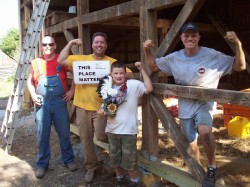
Pictured: Brad, and his son, Kolbe, Holmsten from West Chester, PA; Russ Holmsten from Daytona Beach, FL; family friend, Andy Brown from Overland Park, KS, and Barny, of course!

Earlier this summer Barny dropped by the barn-repair crew at the Brokesh Barn in Republic County, Kansas.  This barn restoration is truly a family effort with determined kin travelling from as far as way as Florida and Pennsylvania!  The rest of the remarkable story will be in the next Kansas Barn Alliance newsletter, The Rural Icon.

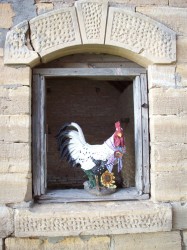
He recently found himself on the window sill of a stone barn at the Hanson farmstead in Cloud County, Kansas, where this 20’x30′ limestone building will be tuck-pointed and have windows & doors installed, so Barny took advantage of the photo opportunity!

Hanson stone building 9.2.13

Barny at the Hanson farmstead in Cloud County.

This incredibly photogenic rooster has been charming his way into many barn and farm events as of late.  Word has it that Barny got the Early Bird Discount and is already registered for the KBA’s BarnFest’13, a two-day conference on October 4th and 5th in Marion County (for further details, visit www.kansasbarnalliance.org).

Barny also plans to attend the Mother Earth News Fair in Lawrence, Kansas, on October 12th and 13th.  The KBA will have a booth there to share information on barn preservation and reuse, and Barny will be on hand to take your questions and pose for pictures with all his barn fans!

It’s true what they say, “Life is never dull in the world of Kansas barns!”  The NBA would sincerely like to thank Susie Haver for sharing updates on all of Barny’s latest adventures, and the wonderful group of Kansans in the KBA hard at work supporting barn preservation in their state!  

Many Firsts at MBPN’s Fall Barn Tour

The information for this post was submitted by NBA member and architect, Charles Bultman.  Charles has been hard at work organizing the MBPN’s Fall Tour for the past several months.  This tour is a first for this region of Michigan and the first barn tour – in the country, as far as we know – to offer Continuing Education credits from the American Institute of Architects (AIA)!
 
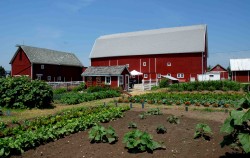
Braun barn

Braun barn

The Michigan Barn Preservation Network’s (MBPN) Fall Barn Tour will highlight at least eight historic barns and farmsteads in Washtenaw County: home of Ann Arbor and the surrounding communities of Chelsea, Clinton, Dexter, Saline, and Ypsilanti.   The tour will be on Saturday, September 21st, starting at 8:00 am from the south side of Ann Arbor and will last all day. Participants will receive a guide book that will include a map and photos of all of the barns on the tour, as well as some historical information about each barn.

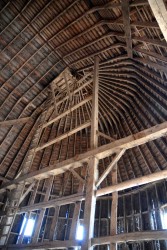
 Parker barn, interior

Parker barn, interior

One of the barns featured on this tour was built in 1826 and is certainly one of the oldest barns in the county.  Another shining star is the circa-1920s Parker Barn: a 178 -foot long and 60-foot wide monumental barn with a 30-by-50-foot working granary to boot!   In all, it is a very nice sampling of barns and farm buildings that illustrate a range of approaches to barns spanning nearly 100 years in Washtenaw County.

Further setting this tour apart is a special dinner on Friday night, September 20th, for those who want to enjoy a farm-to-table meal and a lively conversation about barns in Ann Arbor at Zingerman’s restaurant.  The barn tour also qualifies for AIA Continuing Education credits.  More information on these matters is available upon request.

Rentschler barn

Rentschler barn

For MBPN members, the tour is $60 for the day. The cost for non-members is $90. The tour cost—which allows you to tour all nine barn sites with the group—includes the bus and driver, lunch by Zingerman’s, the guide to the barns on the tour, and bottled water and a snack on the bus. The tour is limited to 54 people, so please reserve your seat early to insure that you will get to tour this impressive collection of barns. Secure PayPal for tour reservations is available on the MBPN website.


Now Showing: A New England Barn Model!

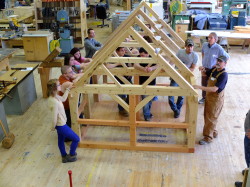
DSCF2012

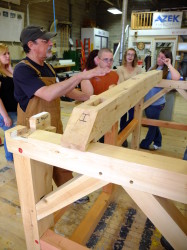
Last winter the NBA was contacted by Tom Musco, a fellow barn-enthusiast and timber framer who was interested in making a barn model that embodied building traditions of New England barns.  Past President, Charles Leik, corresponded regularly with Musco, and members of the Board met this crafty go-getter at the CT Trust’s “Celebration of Barns” last month, just as he was booking the model’s first raisings.

Supplying every bit of the materials, time, and skill involved in construction, Musco based his model on typical English barn dimensions (30’ x 40’) found in the region.  “The model is also based on the research I did when I built the Job Lane barn in Bedford, MA…. a scaled-down reproduction of the barn that was on the site of the Job Lane Homestead.  The original [c. early 1700s] house is still standing and the Town of Bedford and the Friends of the Job Lane House wanted a barn for the house.”

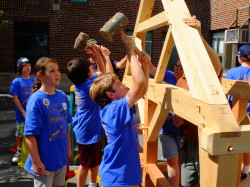
DSCF2085

Tom Musco is a jack of all trades, but has a great deal of experience in timber-frame construction.  When he read about the NBA’s Teamwork & Timbers program, Musco was inspired to create a model to reflect historic New England barns, “…being the husband of a school principal and someone who home-schooled his two children, [I] wanted kids in New England to have the fun of raising a barn frame.” And he has certainly been putting his model to good use!  This summer, Musco has booked a handful of barn raisings, teaching children and adults alike about the region’s rural icons. “What makes the English barn unique and gives it its name is the English Tying Joint at the top of the posts.  This style barn was in use since about 1200 in England and was brought to New England by the English settlers. It was built in New England until the 1850s.”

Tom Musco and his team will be raising the model at the Royalston town library in Royalston, MA, on July 18th, and again at the Timber Framers Guild conference in Burlington, VT, on August 10th.

DSCF1912

Edgemoor Barn Turns 100! Celebration Planned for Saturday, May 11th

Edgemoor Barn 1

This post submitted by Ellen Henry and friends at the Santee Historical Society in Santee, California.  This year, the group is celebrating the barn’s birthday with a big bash to help raise funds for its continued preservation!  To learn more about this event, click here or visit http://www.santeehistoricalsociety.com/

On May 3, 1913, John H. Dupee, a high-society millionaire businessman from Chicago, purchased a nearly 500 acre farm for a reported $85,000.  Dupee purchased the Williamson’s farm for his son, Walter Hamlin Dupee. Dupee, committed to owning the largest dairy farm in the region, went to work on redeveloping the existing dairy into one of the most prestigious dairy farms known. Between 1913 and 1915, Dupee had many new structures constructed on the Edgemoor ranch. The most prominent of these buildings was completed on July 19, 1913, with construction of a large barn intended for his prize-winning team of bulls which represented the breeding stock of his dairy. As well as expanding dairy operations, he introduced the rearing of polo ponies. The barn would later become known to area residents as the ‘Polo Barn’ even though the pony stables were built elsewhere on the property.

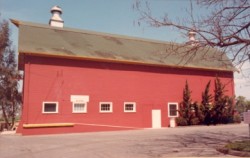
The builder and architect of the barn are unknown but it was built of fir timber construction on a poured, above grade four foot concrete foundation. The exterior siding is redwood tongue and groove clapboard. It was constructed with a Dutch gambrel roof (a ridged roof with two slopes on each side). The roofline is three stories high with large twin cupolas serving as ventilators, making the barn one of the more visible and well-known landmarks in the City. The architecture of the barn is rarely seen in Southern California and very unique in San Diego County.

Alterations to the barn have been relatively minor since 1913, most occurring in 1955 when the County made the building over from an active livestock barn to storage. The most visible of these improvements includes the removal of the exterior sliding barn doors, installation of a concrete loading ramp at the southwest area of the building and enclosure of some of the interior stalls to create offices and locked storage. The top floor and exterior of the barn remain virtually untouched to this day.

In the mid-fifties, the Edgemoor Fire Department was Santee’s  first volunteer fire department and its first fire truck was garaged at the Edgemoor Barn.  Following the 1955 remodeling, the barn was used by Edgemoor Hospital as a central supply warehouse and storage facility until February 2007 when the Santee Historical Society moved into the building.

In September of 1983 the barn was saved by placing it on the National Register of Historic Places. On May 16, 1985, after hard work by people dedicated to saving it, the Edgemoor Barn was listed in the National Register of Historic Places by the United States Department of the Interior.

Edgemoor Barn_ca 1985

Edgemoor Barn circa 1985

In addition to acknowledging the importance of the distinctive Dutch Gambrel architectural style, its size, its condition and consideration of being historically valuable the designation on the National Register will also protect the barn from future modifications and demolition, thereby preserving the building for future generations to enjoy.

The barn in its original location is the last remaining original structure from the Dupee era. Still visible from Magnolia Avenue, the barn and the land it sits on, continue since 1923 to be owned by the County of San Diego.

Agriculture in the San Diego region has changed dramatically by urban competition for land. A drive through San Diego County will soon make you aware of how few barns still exist. Historic barns are a vanishing feature of the American landscape. The wooden barn, once found on virtually every farmstead in the country, has disappeared.

This elegant barn is one of the oldest, if not the oldest building in Santee. It is still around because it was well built by Dupee in 1913, and well kept over its one hundred years of existence. The building, painted to match its original colors of green and white, remains as an outstanding symbol of an era when dairy farming was important to the industry and culture of San Diego.

A Traditional Marriage: Historic Barns & Beautiful Quilts

This article was submitted by Suzi Parron, author of Barn Quilts and the American Quilt Trail Movement.  We are thrilled to connect with Ms. Parron and others active in the barn quilt movement.  The NBA sees the use of quilt blocks and historic barns  behind them, acting as a canvas, to be an enchanting (and culturally significant!) reflection of men and women’s traditional work on farms across the country.  

The historic barns of Kittitas County, Washington, are receiving quite a bit of attention these days.  Several local barns have been decorated with barn quilts—quilt patterns painted on wood and mounted on the barn surfaces for passersby to see. The effort marks the beginning of the state’s first quilt trail, which encourages visitors to travel the rural countryside and creates renewed appreciation for the area’s barns.  Half of the forty barns that make up the first phase of the trail are more than 100 years old, and the remainder date to the 1960s or earlier.
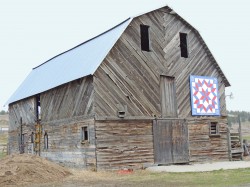
Ballard Barn and Wagon Wheel Quilt Block, Photograph by Jacqueline Fausset

Ballard Barn and “Wagon Wheel” Quilt Block, Photograph by Jacqueline Fausset

One of the most notable is the Ballard barn in Cle Elum, built in 1900 by the original homesteader, Miles Clinton Ballard. Ballard was a skilled carpenter whose barn is unique among those in the area, designed to survive the valley’s spring winds that often gust up to 60 miles per hour. He designed the barn with lateral boards on the first story and diagonal bracing on the upper half.The barn was originally used to store hay and to shelter draft horses and also housed calving cows as needed.  It is still in active use to store hay and farm equipment. Current owner Chuck Ballard is the sixth generation of his family to occupy the farm, which still has all of its original homestead acres intact. The Wagon Wheel quilt block was chosen because it reminded Chuck of the wagons and buggies that were used on the farm when he was a child.  He and wife Bev decided upon a patriotic color scheme to honor their late son Greg, a well-loved and respected firefighter in Cle Elum.

The Barn Quilts of Kittitas County are part of a movement that began with Donna Sue Groves in Adams County, Ohio.  Groves and her mother, Maxine, moved to a farm in 1989 that included a tobacco barn.  The circa 1950 barn, like most built for drying tobacco, was plain in appearance—a very simple gable-entry design. Groves was struck by the idea of adding a painted quilt square above the sliding doors to honor her mother’s renowned quilting and the family’s Appalachian heritage.  When it came time to complete the project, Groves suggested that twenty barn quilts could be painted and placed along a driving trail that would invite visitors to travel through the countryside.  In 2011, an Ohio Star was painted by local artists and installed on a small barn nearby, and the trail of twenty quilt blocks—including one on the Groves barn—was completed over the course of three years. The Ohio Star is one of the most popular barn quilt patterns in its home state and beyond.
Michael Barn and "Ohio Star" Quilt Block

Michael Barn and “Ohio Star” Quilt Block

The Ohio Star is one of the most popular barn quilt patterns in its home state and beyond.  In Urbana, Ohio, this pattern marks the barn owned by Todd and Jill Michael. The Michaels have owned the property for nearly fifteen years and spent a lot of time researching its history. The 1850 Pennsylvania bank barn and late-19th century, 12-sided addition were present in 1896, when Chauncy Glessner received the farm as a wedding gift from his father.  Each of the 12 sides corresponds to a stall below with an interesting feature—round, polished stanchions. According to Michael, broom handles were manufactured in Urbana and were commonly used in barns nearby.  Restoring the barn was a project for Michael.  The barn’s current appearance belies its age, and the Michaels regularly find visitors pulling up their long driveway to get a closer view of one of Ohio’s treasures.

From its beginnings in Ohio, the barn quilt movement has expanded to 44 states and Canada.  Over 4,000 quilts are part of organized trails; hundreds more are scattered through the countryside, not part of an organized effort.  A drive along the quilt trail appeals to barn enthusiasts and to those who appreciate the iconic quilt patterns.  A quilt trail near her home in Callaway, Kentucky caught the eye of Posy Lough. Lough creates needlework patterns that celebrate American heritage, so barn quilts were a perfect addition to her “Posy Collection.”  The Redwork Quilt Kit features 12 barn quilt patterns from across the country. Included are the Ohio Star, the Snail’s Trail pattern that graces the Groves barn, and an unusual design called LeMoyne with Swallows, which is found on a Century Farm in Johnson City, Tennessee.
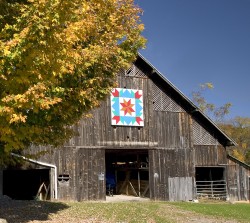
Epperson Barn and LeMoyne with Swallows

Epperson Barn and “LeMoyne with Swallows” Quilt Block

LeMoyne with Swallows is a reproduction of a cloth quilt sewed by the grandmother of farm owner Marcella Epperson.  Epperson’s grandparents, Isaac and Barbara, inherited the property acquired by the family in 1848.  Epperson recalls the barnyard in the 1940s and 50s: “There were horses, cows, mules, hogs, chickens, ducks, and guineas–pretty much everything. It was like Old MacDonald’s farm!” The 1898 gable-roofed barn housed livestock until the late-20th century and now sits mostly empty, a hidden gem enjoyed by those who seek it out along quilt trail.

One of the most well-traveled quilt trails is in Kankakee County, Illinois. The Kankakee trail includes a couple of corn cribs like the 1934 structure on the Larson farm.  Dean Larson and his sister Beverly are proud of the hard work that the crib represents.  Dean recalls, “The corncrib was the mainstay of our working farm, especially since our father raised livestock. The crib not only stored his entire harvest of corn and dried the ear corn on the vented sides, but also stored smaller grains such as beans in the overhead bins. Our father ground his stored ear corn for cattle feed in a hammer mill contained in the corn crib. Since our corncrib was a valuable asset to our family farm, we decided to honor it with a barn quilt entitled “Corn and Beans.”
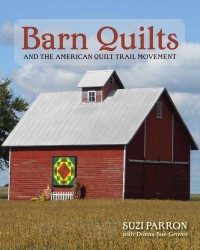
Parron book coverThe Larson corncrib was selected for the cover of “Barn Quilts and the American Quilt Trail Movement.”  The book traces the trail to its beginnings in Ohio and takes readers to 29 states from New York to Colorado with over 80 photographs taken along quilt trails across the country. It also includes dozens of interviews with barn owners, who relate the significance of their chosen quilt patterns along with stories about the barns on which they are mounted.

Each of the 150 known barn quilt trails celebrates a community’s farming heritage.  Although quilt squares are the main attraction,barn enthusiasts may find quilt trail maps to be invaluable guides in their travels through America’s countryside. Information about Parron’s book, The Posy Collection, and the nation’s quilt trails can be found at www.barnquiltinfo.com.