This article was submitted by Suzi Parron, author of Barn Quilts and the American Quilt Trail Movement. We are thrilled to connect with Ms. Parron and others active in the barn quilt movement. The NBA sees the use of quilt blocks and historic barns behind them, acting as a canvas, to be an enchanting (and culturally significant!) reflection of men and women’s traditional work on farms across the country.
The historic barns of Kittitas County, Washington, are receiving quite a bit of attention these days. Several local barns have been decorated with barn quilts—quilt patterns painted on wood and mounted on the barn surfaces for passersby to see. The effort marks the beginning of the state’s first quilt trail, which encourages visitors to travel the rural countryside and creates renewed appreciation for the area’s barns. Half of the forty barns that make up the first phase of the trail are more than 100 years old, and the remainder date to the 1960s or earlier.
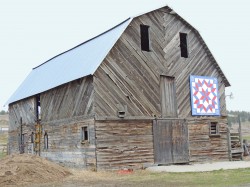
Ballard Barn and “Wagon Wheel” Quilt Block, Photograph by Jacqueline Fausset
One of the most notable is the Ballard barn in Cle Elum, built in 1900 by the original homesteader, Miles Clinton Ballard. Ballard was a skilled carpenter whose barn is unique among those in the area, designed to survive the valley’s spring winds that often gust up to 60 miles per hour. He designed the barn with lateral boards on the first story and diagonal bracing on the upper half.The barn was originally used to store hay and to shelter draft horses and also housed calving cows as needed. It is still in active use to store hay and farm equipment. Current owner Chuck Ballard is the sixth generation of his family to occupy the farm, which still has all of its original homestead acres intact. The Wagon Wheel quilt block was chosen because it reminded Chuck of the wagons and buggies that were used on the farm when he was a child. He and wife Bev decided upon a patriotic color scheme to honor their late son Greg, a well-loved and respected firefighter in Cle Elum.
The Barn Quilts of Kittitas County are part of a movement that began with Donna Sue Groves in Adams County, Ohio. Groves and her mother, Maxine, moved to a farm in 1989 that included a tobacco barn. The circa 1950 barn, like most built for drying tobacco, was plain in appearance—a very simple gable-entry design. Groves was struck by the idea of adding a painted quilt square above the sliding doors to honor her mother’s renowned quilting and the family’s Appalachian heritage. When it came time to complete the project, Groves suggested that twenty barn quilts could be painted and placed along a driving trail that would invite visitors to travel through the countryside. In 2011, an Ohio Star was painted by local artists and installed on a small barn nearby, and the trail of twenty quilt blocks—including one on the Groves barn—was completed over the course of three years. The Ohio Star is one of the most popular barn quilt patterns in its home state and beyond.
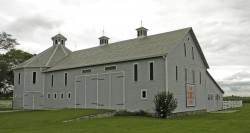
Michael Barn and “Ohio Star” Quilt Block
The Ohio Star is one of the most popular barn quilt patterns in its home state and beyond. In Urbana, Ohio, this pattern marks the barn owned by Todd and Jill Michael. The Michaels have owned the property for nearly fifteen years and spent a lot of time researching its history. The 1850 Pennsylvania bank barn and late-19th century, 12-sided addition were present in 1896, when Chauncy Glessner received the farm as a wedding gift from his father. Each of the 12 sides corresponds to a stall below with an interesting feature—round, polished stanchions. According to Michael, broom handles were manufactured in Urbana and were commonly used in barns nearby. Restoring the barn was a project for Michael. The barn’s current appearance belies its age, and the Michaels regularly find visitors pulling up their long driveway to get a closer view of one of Ohio’s treasures.
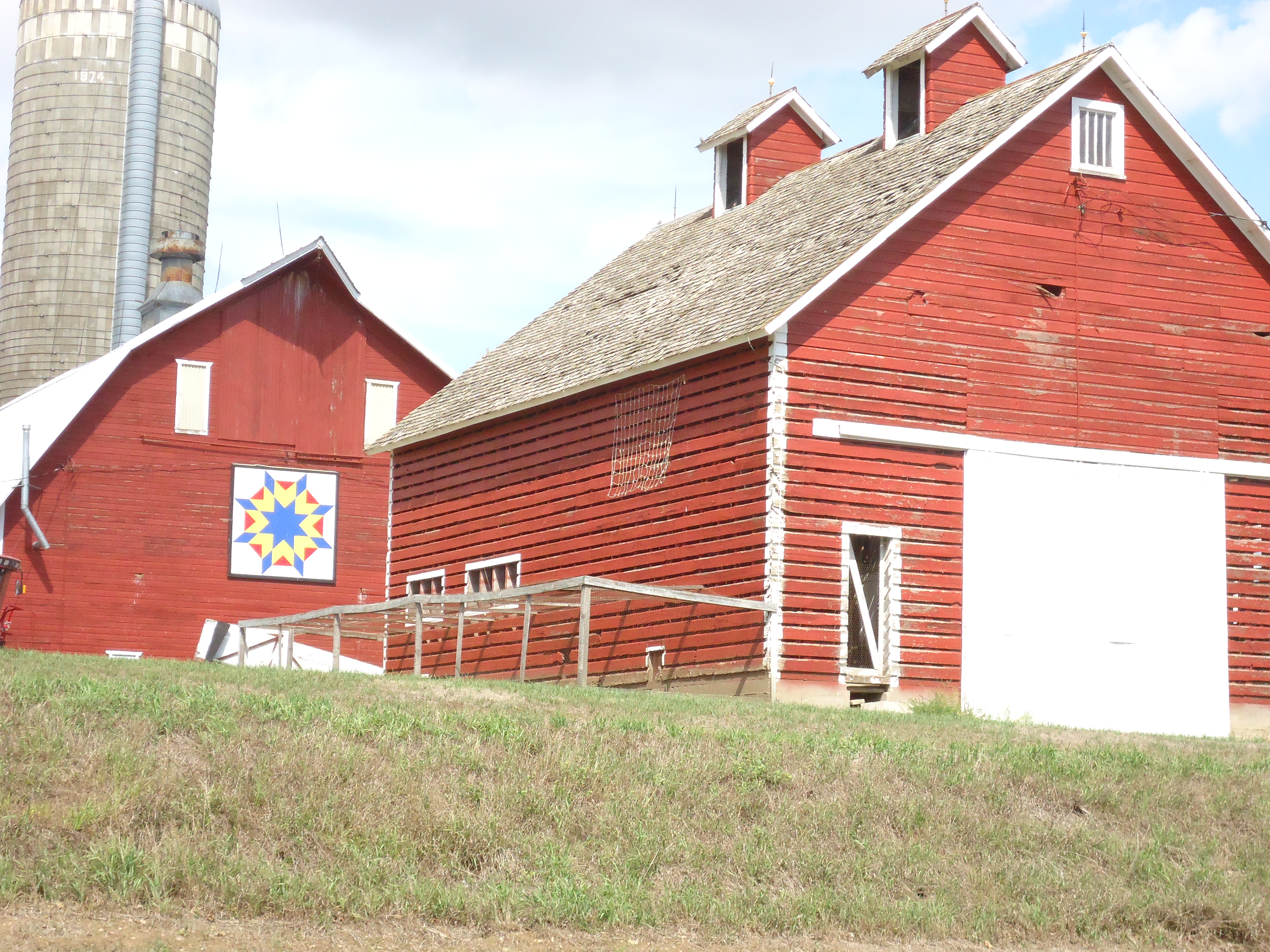
From its beginnings in Ohio, the barn quilt movement has expanded to 44 states and Canada. Over 4,000 quilts are part of organized trails; hundreds more are scattered through the countryside, not part of an organized effort. A drive along the quilt trail appeals to barn enthusiasts and to those who appreciate the iconic quilt patterns. A quilt trail near her home in Callaway, Kentucky caught the eye of Posy Lough. Lough creates needlework patterns that celebrate American heritage, so barn quilts were a perfect addition to her “Posy Collection.” The Redwork Quilt Kit features 12 barn quilt patterns from across the country. Included are the Ohio Star, the Snail’s Trail pattern that graces the Groves barn, and an unusual design called LeMoyne with Swallows, which is found on a Century Farm in Johnson City, Tennessee.
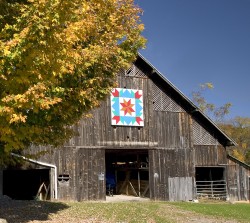
Epperson Barn and “LeMoyne with Swallows” Quilt Block
LeMoyne with Swallows is a reproduction of a cloth quilt sewed by the grandmother of farm owner Marcella Epperson. Epperson’s grandparents, Isaac and Barbara, inherited the property acquired by the family in 1848. Epperson recalls the barnyard in the 1940s and 50s: “There were horses, cows, mules, hogs, chickens, ducks, and guineas–pretty much everything. It was like Old MacDonald’s farm!” The 1898 gable-roofed barn housed livestock until the late-20th century and now sits mostly empty, a hidden gem enjoyed by those who seek it out along quilt trail.
One of the most well-traveled quilt trails is in Kankakee County, Illinois. The Kankakee trail includes a couple of corn cribs like the 1934 structure on the Larson farm. Dean Larson and his sister Beverly are proud of the hard work that the crib represents. Dean recalls, “The corncrib was the mainstay of our working farm, especially since our father raised livestock. The crib not only stored his entire harvest of corn and dried the ear corn on the vented sides, but also stored smaller grains such as beans in the overhead bins. Our father ground his stored ear corn for cattle feed in a hammer mill contained in the corn crib. Since our corncrib was a valuable asset to our family farm, we decided to honor it with a barn quilt entitled “Corn and Beans.”
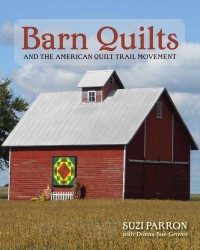 The Larson corncrib was selected for the cover of “Barn Quilts and the American Quilt Trail Movement.” The book traces the trail to its beginnings in Ohio and takes readers to 29 states from New York to Colorado with over 80 photographs taken along quilt trails across the country. It also includes dozens of interviews with barn owners, who relate the significance of their chosen quilt patterns along with stories about the barns on which they are mounted.
Each of the 150 known barn quilt trails celebrates a community’s farming heritage. Although quilt squares are the main attraction,barn enthusiasts may find quilt trail maps to be invaluable guides in their travels through America’s countryside. Information about Parron’s book, The Posy Collection, and the nation’s quilt trails can be found at www.barnquiltinfo.com.