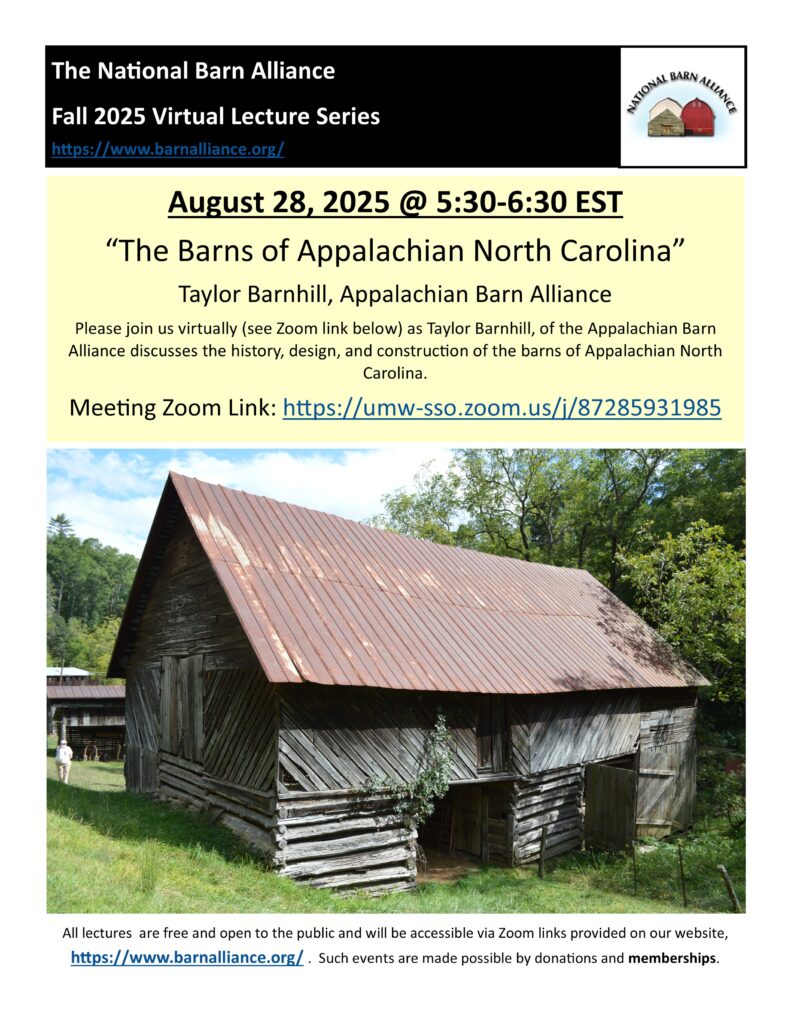
“The Barns of Appalachian North Carolina”: Presented as part of the National Barn Alliance, Fall 2025 Virtual Lecture Series August 28, 2025 @ 5:30-6:30 EST

Taylor Barnhill of the Appalachian Barn Alliance will present the first lecture in the National Barn Alliances FREE Fall 2025 Virtual Lecture Series entitled “The Barns of Appalachian North Carolina”. The lecture will examine the history, design, and construction of the regions barns. Three additional free lectures will be presented as part of the series in September, October, and November. Please consider becoming a member of the National Barn Alliance to support these efforts as well as receive notifications and updates (https://www.barnalliance.org/join-us/).

The lecture can be accessed on August 28, 2025 @ 5:30 using this Zoom link,https://umw-sso.zoom.us/j/87285931985

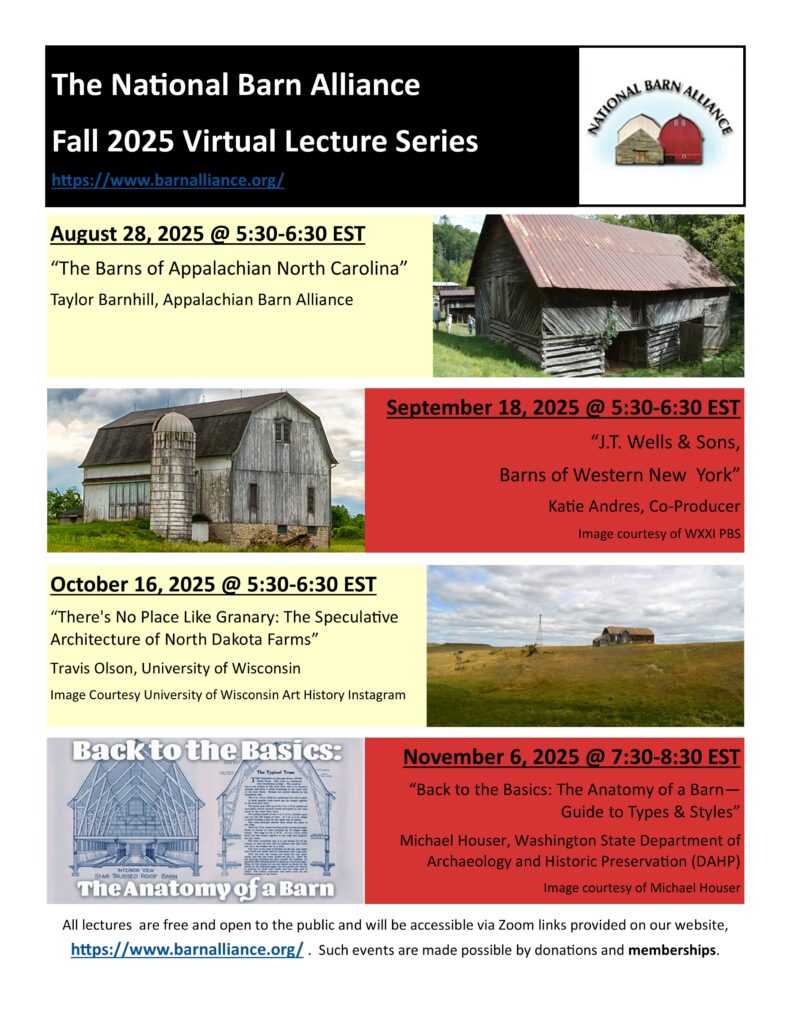
National Barn Alliance Fall 2025 Virtual Lecture Series

We are happy to announce our fall 2025 virtual lecture series which will cover a wide range of barn related topics, not just the East Coast! As we get closer to each lecture Zoom links will be posted on the webpage and on our Facebook page, so stay tuned. All lectures are free and open to the public thanks to memberships and donations. If you are interested in helping us continue this work please see our membership page (free memberships to students and non-profit organizations).

NBA Virtual Lecture #9: “Using Pennsylvania’s Agricultural Context to Evaluate Historic Farms”

Come join the National Barn Alliance via Zoom on November 7, 2024 at 6 pm to hear Barbara Frederick, Division Manager for Environmental Review at the Pennsylvania State Historic Preservation Office, discuss the Pennsylvania Agricultural Context which was developed in 2013. Still one of the best agricultural contexts created in the country (find it here, Pennsylvania Agricultural History Project ) for understanding historic agriculture practices and the landscape, Barbara will discuss changes they have made over the years as well as upcoming efforts. Much of these efforts will focus on the development of guidelines for evaluating National Register eligibility associated with barn types. While focused on Pennsylvania, the methods used and developed to create the context are applicable to other states as well.

The lecture is free and open to the public.

Zoom Link: https://umw-sso.zoom.us/j/81251530160

Share Your Story with the NBA: Write for our newsletter, e-news, and blog!

NBA Newsletter ScreenshotThe National Barn Alliance is seeking articles and contributors for our newsletter, “The Barn Door,” our e-newsletter and our blog, “The Barn Journal.”  The “The Barn Door” is bi-annual publication mailed to our membership.  Articles may also be posted on here, on “The Barn Journal,” and shared via the NBA’s Facebook, Twitter, Linked In page, or Youtube channel.

We encourage individuals as well as our state and local barn preservation partners to share updates on their activities. This is an opportunity to share your successes with others working to save historic barns in their own states. Article topics must be barn-focused such as history/preservation, grant programs, kids & education, photos, art, barn facts, endangered barns, saved barns, repair tips, preservation tips, book review, surveys & studies, barn raisings, and tours. We are also taking calendar submissions for conferences, tours and events.

Submission guidelines:

– Suggested length is 300 – 600 words. Photos are highly recommended.

– Send article in a MS Word, iWorks Pages, or as text in the body of the email.  Photos are preferred in .jpeg format as attachments with captions.


Articles for online publication are rolling.  Submission Deadlines for the printed newsletters are:

Fall/Winter Newsletter: August 16

Spring/Summer Newsletter: March 22

Contact us for our easy to use template at info@barnalliance.org.

__

Can you imagine an America without barns dotting the plains or hills? We can’t. Join us in preserving our heritage. Before it is lost. Join us

The Doncaster Barn or Bayers Barn

Round Barn - Cropped


A guest post by NBA member, Jill Hotchkiss.

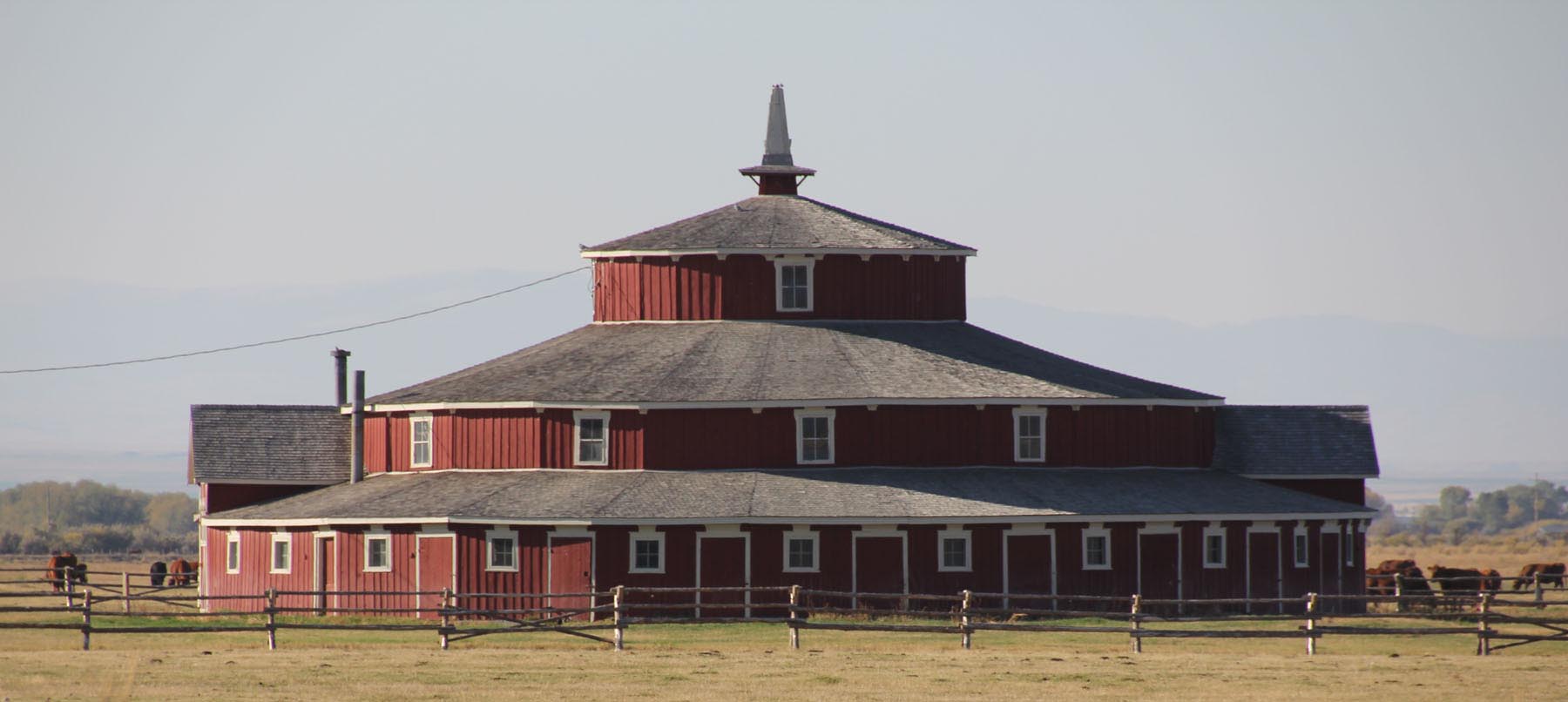
The old round barn just outside Twin Bridges, Montana was built in 1882 by Noah Armstrong, one of the lesser known Copper Kings, who was at that time superintendent of the Glendale smelter and discoverer of the Hecla mine in western Montana. Being from Kentucky, Armstrong had a love for horses and horse racing. He purchased the ranch in 1882 calling it the Doncaster Ranch after one of his favorite race horses. He then built a magnificent three-story round barn in which to raise and train race horses. One of the reasons he built it round was so the horses could be exercised in the winter on the indoor track on the ground floor. The ground floor also had box stalls for the horses as well as a saddle/tack room, veterinarian’s room, grain bins and office and living quarters for the jockeys or stablemen. The second story housed hay which could be fed to the horses on the ground floor, through openings or chutes on the second floor. The third floor had a large water tank which was pumped there from the well which was underneath the barn and a windmill which was atop the barn. Water could then be pumped anywhere in the barn, under pressure. There was also a freight elevator to transport the hay, grain and anything else to the second floor. This was quite a fancy barn for the day. There was even a carved horse scene above the front doors of the barn. The barn’s claim to fame, however, was raising Montana’s only Kentucky Derby winner, Spokane, who won the race in 1889. Actually, at that time in history he was the equivalent of a Triple Crown winner, the slate of races being different than they are now.

This article is published in our printed in Winter 2012 newsletter, The Barn Door.

__

Can you imagine an America without barns dotting the plains or hills? We can’t. Join us in preserving our heritage. Before it is lost. Join us