Secretariat’s Virginia Roots: The Meadow Farm to be Auctioned on May 22nd

Guest Post by Danae Peckler, Architectural Historian and Board Member of the National Barn Alliance

Recently listed on Preservation Virginia’s Most Endangered Historic List of 2012, The Meadow Farm, will be  auctioned off on May 22nd at 2:00pm EST. Birthplace of the 1973 Triple Crown-winner Secretariat, the 331 acres that remains of The Meadow is situated within Caroline County, Virginia, just east of Interstate 95. Nearly 34 years after the Chenery family sold the farm, it is now threatened by the development pressures that accompany any property near an Interstate exit. But it is perhaps more at risk from those who do not know its rich, yet humble history.

In 2006, The Meadow was determined to be eligible for listing on the National Register of Historic Places by the Virginia Department of Historic Resources (SHPO).  Although the main house was no longer standing at that time, it was determined that the historic significance of The Meadow as a notable twentieth-century breeding and training farm of Thoroughbred racehorses was clearly conveyed through the physical components that survived from the Chenerys’ tenure.

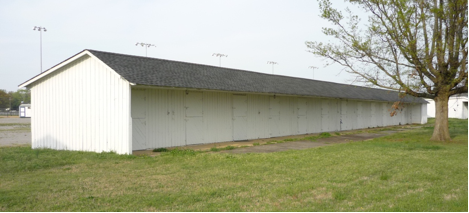
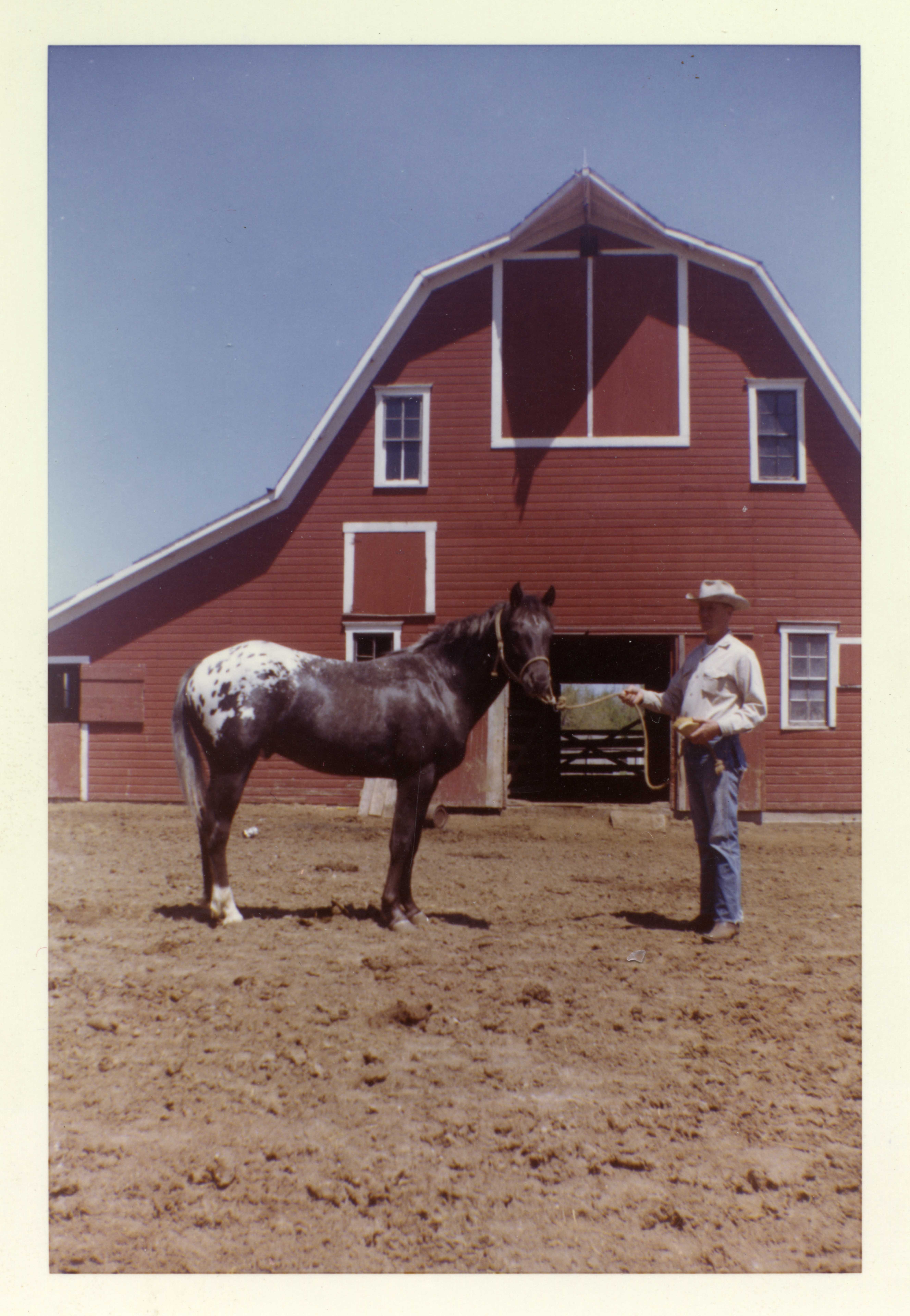
Extant historic features at The Meadow include a number of training, yearling, stallion and broodmare barns, as well as the foaling shed where Secretariat was born in 1970.  Other historic structures such as machine sheds, hay barns, secondary dwellings, garages, a pump house, and a horse cemetery also remain. But perhaps more telling, and less visible to the “urban” eye, are the various historic landscape features, including the path of the old racetrack, numerous paddocks and pastures, fences lines, farm roads, and field patterns—all of which continue to reflect The Meadow’s equine and historic agricultural use for the past 250 years.

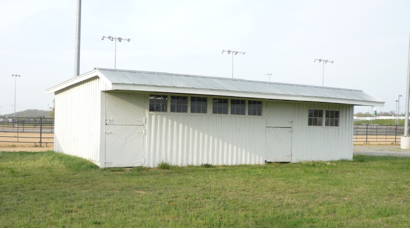
Secretariat’s Foaling Shed has been relocated from the pasture behind the main house to the middle of the old racetrack, where it is preserved as an artifact for State Fair patrons to observe, near the new equine facilities.


The historic buildings, structures, and landscape features at The Meadow comprise the birthplace of a great champion, but these elements also reflect the dedication and hard work of a prudent horseman.  The story of Christopher T. Chenery and his Meadow farm was recently published in Secretariat’s Meadow, a book by Chenery’s granddaughter, Kate Tweedy, and Leeanne Ladin.  The book tells the tale of how a man from little wealth came to own one of the most celebrated racehorses in history, and how his family’s ties to a farm in Caroline County carried him back to ‘Ole Virginny.’ In addition to establishing the Meadow Stable, Christopher Chenery was instrumental in the creation of the New York Racing Association (NYRA), the non-profit organization that continues to oversee the Belmont, Saratoga and Aqueduct racetracks, and shaped horse racing on the East Coast for much of the twentieth century.

Building on her father’s dedication, Penny Chenery Tweedy enabled the success of Secretariat, but also the 1972 Derby winner, Riva Ridge.  Penny’s own contribution to sport of Thoroughbred horseracing in the late-twentieth century cannot be understated.  All told, the Chenery family’s hard work has immortalized a little piece of land in Caroline County, and endeared it to the hearts of countless Americans.  The physical landscape at The Meadow continues to tell their story, and the story of so many people (and horses!) that helped bring the farm’s history to life, to those of us who look to listen.

But don’t be fooled, The Meadow is not the horse farm we see in today’s movies.  This farm was not lavishly built by an oil tycoon and it did not become the corporate headquarters of international investors in the racing industry.  Its historic barns and farm buildings are not grandiose in size or architectural detail.  The historic fence lines and gateways on the property are not enlarged signposts—there was certainly no need for billboard-like advertising in Chenery’s era—everybody knew where the farm was located and who was working there.  And if you didn’t, you just had to ask someone local.

This training barn is one of the few original features remaining on the south side of the farm, and is located in the center of the old racetrack. This barn and the foaling shed are now largely surrounded by pavement and enclosed behind a tall metal fence.


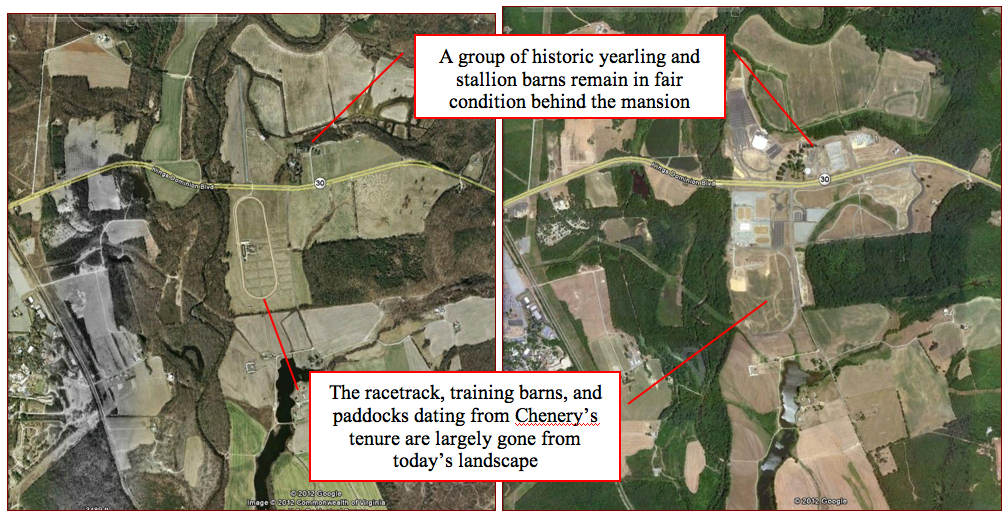
Today, The Meadow continues to be a rare find among celebrated mid-twentieth century horse farms.  Despite improvements made by subsequent owners and new construction associated with the State Fair of Virginia (SFVA), the authenticity of this culturally significant historic landscape remains visible, with much of it lying just beneath the surface.  Aerial photographs taken in the mid-twentieth century reveal that the air-strip, observation tower, and current mansion were added in the mid-1980s, while the SFVA has added parking lots, event buildings, and new roadways since their occupation in 2009.

Satellite imagery illustrates the farm’s transition to host the SFVA. Pictured at the left is an aerial view of the farm in 2002, and at right, an image taken in 2010 (Google Earth).


Given the farm’s high-level of historic significance, it is hoped that the farm’s new owners will be sensitive to historic fabric that remains of Secretariat’s Meadow farm, and perhaps even restore some of Chenery’s design.  No one needs to gussy up the real deal; The Meadow’s visitors would be better served by even a slice of an authentic experience of Virginia’s most well-known horse farm.

If you are interested in learning more about the farm’s auction next week, please visit the website of Motley’s Auction House and click on the 331-acre Virginia State Fairgrounds Complex in Doswell, Virginia (http://www.motleys.com/index.php).  The auction will be held “on site” and “on line,” but online bidders must be registered by May 18th at 3:00 pm EST.

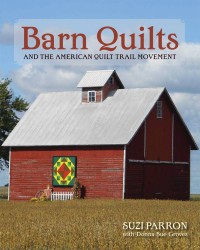
Book Review: Barn Quilts and the American Quilt Trail Movement

Book review by Charles Leik, Chair of the National Barn Alliance.

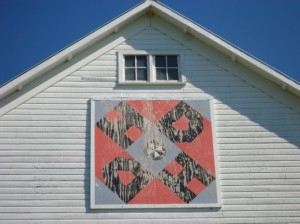
It was at the National Barn Alliance’s (NBA) 2009 Shaker Hill, Kentucky conference that I first learned about the phenomenon of Quilt Barns. Several Kentucky ladies gave an enthusiastic presentation and the next day as I drove serpentine secondary roads northward to the Ohio River I saw perhaps a dozen of the “Real Deal” –8’ x 8’ squares of a favorite quilting pattern on weathered barns.

I already had an acquaintance with quilting as I recalled mother and her friends working at the quilting frame set up in our parlor in the early 1950s. The ladies seated around the frame chatted while with practiced skill made small, uniform stitches to sew the pattern to the batting.

In addition to this tenuous connection to quilts I have been long engaged in preservation of our heritage barns and anything that draws attention to these endangered structures and causes them to be maintained is a positive for me.

With this background I was pleased to learn that the Ohio University Press, Athens released in early 2012 a volume devoted to the history of the quilt barn movement.

The book printed on high quality paper with dozens of captioned photographs is everything that a lover of traditional folk culture could desire. Author Suzi Parron and barn quilt pioneer Donna Sue Groves take the reader to the origins of the Quilt Trails in Appalachia and then to other states, particularly those of the Heartland. There are individual chapters on Tennessee, Kentucky, North Carolina, Ohio, Iowa, Illinois, Wisconsin and Michigan as well as chapters devoted to local events in which the author participated.

The reader meets the dozens of local heroines (and heroes) who organized the Trails in their communities. I was pleased that a photo of the quilt art on the owner’s barn accompanied the discussion of a pattern and its personal importance to the family.

Cindi Van Hurk, Michigan is representative of the many quilt trail pioneers in stating, “The Alcona County Quilt Trail Project has a very positive impact on our economy, while also fueling community pride within all areas of our county.”

This reviewer was happy to read the author’s conclusion that, “An unexpected benefit of the project has been the preservation of barns and other farm buildings.”

Barn Quilts and the American Quilt Trail Movement is highly recommended for a quick education of this art genre and for aficionados of American vernacular architecture. Barn Quilts is a 240-page paperback at $29.95 by Swallow Press/Ohio State University. Order from University of Chicago Distribution Center, 11030 South Langley Ave., Chicago, IL 60628 or call 773.702.7000.

Hidden in Plain Site: Side-Gabled Log Barn

This is a guest post by Jeroen van den Hurk, Ph.D. He is an Architectural Historian based in North Carolina.

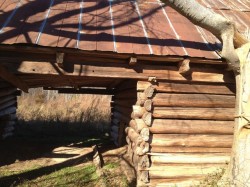
You never know what the lush climate of North Carolina hides until the dead of winter. While out of a drive on Sunday afternoon, I came across this abandoned side-gabled log barn in Halifax County, NC. This is an unusual building for eastern North Carolina. It was a one-story, double-pen or dogtrot structure used to store hay. It appeared to be an earthfast building with the log sill laid directly on the ground.  The logs were halved and saddle notched at the corners, and there was evidence of pegs near the center of the walls to keep the logs together.  The plate was hewn, and there was evidence of both cut nails and wire nails, suggesting that the barn was at least 100-years old.  The rafters may have been replaced at some point and the roof was clad in a standing-metal seam roof. One of the gable ends still had the original weatherboard siding, whereas the other gable end was covered with standing-seam metal.

Time, storms, and neglect had taken it’s toll, but it was still standing.


More photos of this barn:

The Grooms’ Heritage Barn. How a Family Restored their 1915 Stockman’s Barn

This is a post by Charles Leik. Charles is chairman of the National Barn Alliance.

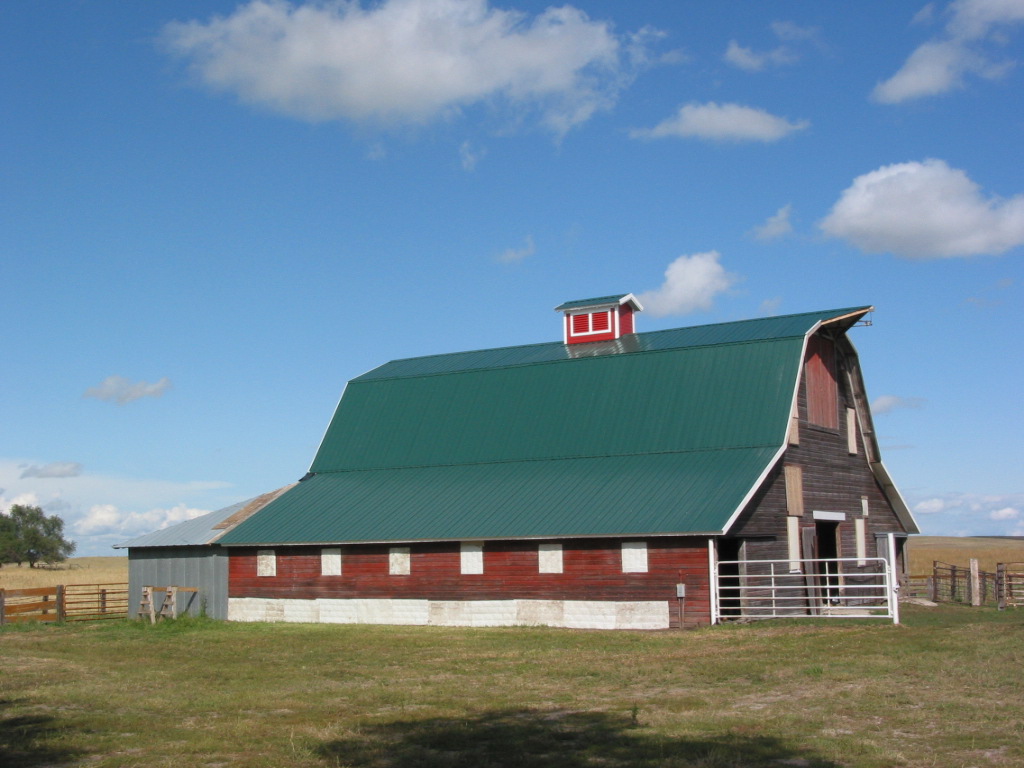
It was James Grooms’ great-great grandfather (five generations back) Martin Becker, a German immigrant, who settled in north central Nebraska (Cherry County) in the 1880s.  He built a typical barn for this ranching and diversified farming area that housed the cattle, work horses and several cows that produced milk for family use.


According to family lore, this first Becker did well given high wheat prices during WWI and as a result raised his second barn around 1915, which was a very large barn for the area.  Mr. Becker soon retired and passed the ranch and barn to his daughter Anna and son-in-law Edgar J. Grooms.


During the ‘dirty 30’s’ the barn was lifted up and set down by a tornado. At that time, it was disassembled, turned to face a different direction and rebuilt with the addition of large side sheds that highlight the changes in farming occurring. It also lost one of the cupolas.  In the 60’s a metal-covered north shed was added, which provided ample space for the growing cattle feeding operation and move from diversified farming. At this time James’ grandfather George and his sons entered the purebred Angus bull business, i.e. sold select breeding stock for other ranchers.


By the 80’s, like so many other western barns, the deterioration was underway as the cattle feeding operation changed and purpose built pole barns were constructed.   First it was the loss of the cupola from high winds and then gradually the prairie winds blew off the wood shingles installed in 1933.  Fortunately the foundation was of poured concrete and dated from this same reconstruction, thus the structure was solid.


In 2007 the Grooms family decided to rescue the barn, the centerpiece of the 26 Ranch and repository of so many memories.  In the winter of 2008 a replacement cupola was constructed on the ground.  Dimensions were determined from old photographs and in the spring a crane raised the module at the gable end to a location past the hay hood, and “come alongs” winched the cupola mounted on skids along the ridge to a central location.


The weathered wood shingles were gradually replaced with a metal roof.  Family members did the labor over the Memorial, Fourth of July and Labor Day holidays.  The roofing began with the west top level and the pressure mounted after the old shingles were removed in stages. As a level was stripped, the steel had to be installed before the end of the holiday to cover the exposed deck.  Four weeks were required to do the west side (the Memorial Day and Fourth holidays) and after gaining experience, only two weeks on the east side (Labor Day).


James, who lives 600-miles away in Kansas City built window sills, moldings, some of the four-pane windows and some doors at his residence during the winters.  He worked hard to save a number of the original windows and their unique period glass. This leaves barn siding repair (to be complete in part with reclaimed wood from another Becker barn!), painting and replacement of detail trim for the future.  But as James says contemplating the future, “she’s high and dry and time is on our side now.”


James stresses that except for the rented crane, that family members provided all the labor.  “There was no way we could afford or justify the labor to install the roof.  However, after a slow start my father, Alfred, and I became pretty adept at installing steel.  And, all the rest is pretty much basic carpentry”.


The James family took an intimidating job and divided it into segments over a number of years that made it both manageable and affordable.  James, a passionate barn lover, concludes that, “I tell everyone…that you can do this yourself”.

Attend The Annual Conference! Joint Conference with the Friends of Ohio Barns.

Example of Keynote Speakers Scott Carlson

Join the Friends of Ohio Barns for their thirteenth annual conference in collaboration with the National Barn Alliance! It will be an entertaining and informative conference and barn tour on April 27th and 28th, 2012 in Summit County, OH. Summit County is home to the Cuyahoga Valley National Park and the Cuyahoga Countryside Conservancy Program.

Homebase for the conference is the Clarion Inn & Conference Center (240 E Hines Hill Rd, Hudson, OH 44236; phone # 330-653-9191). The barn tour will include some of the barns in the conservancy as well as learning about the program from Darwin Kelsey Executive Director of the Cuyahoga Countryside Conservancy Program. Founded in 1999 as a way to rehabilitate old farms and put them back to work under the guidance of the Conservancy. It has been a very successful program on many levels and Mr. Kelsey will have a lot to say on the subject. We also have a panel of farmers from the program, including Alan Halko,Daniel Greenfield and David Wingenfeld, to talk about their experiences and how they fit into the Conservancy Program.

The Keynote Speaker will be Scott Carlson, timber framer, woodworker, and craftsman extraordinaire. Although Scott would say, “I’m just a simple carpenter” you will find that is not the case after seeing some of his work. Scott graduated from the University of Montana as a forester, which has immensely helped him in the woods to find just the right trees to craft his cruck frames. We are thrilled to be able to have him take us on a journey from “Tree to Frame” on Saturday at the conference.

History buffs will thoroughly enjoy David Snider from Somerset, Ohio. His topic for the conference is titled Agricultural Juggernaut: “The Jeffersonian Agrarian Vision meets the best damned farm ground on God’s footstool”. David is from a long line of barn builders, lumbermen and Ohio pioneers. He is a graduate of Hocking College and Ohio University and works as a modern agricultural structure designer/builder. He is a past president and trustee of the Perry County Historical Society and an unreconstructed devotee of early Ohio History. A must see presentation.

Of course the conference would not be complete without the Barn Detectives, Rudy Christian and Larry Sulzer. They will be available on Friday’s tour to point out unusual joinery and well as present their findings at the conference on Saturday. The annual member meeting will be conducted during the lunch break and the silent auction will be ongoing all day as well as other exhibits, demonstrations and vendor presentations.

Conference Registration Information

Full conference package includes Friday chartered bus tour, morning coffee and donuts, catered lunch, and tour booklet; Saturday conference
presentations/demonstrations, conference booklet, continental breakfast, and buffet lunch.Saturday only package includes presentations/demonstrations, continental breakfast, buffet lunch, and conference booklet.Ohio Friends/NBA member conference fee – $130
— Spouse/Partner – $100
Non-member conference fee  – $150
— Spouse/Partner – $120
Saturday only member fee – $80
— Spouse/Partner – $70
Saturday only non-member fee – $100
— Spouse/Partner – $90
You can register online or send in via mail

Reduced rates for Early Registration (before March 31):

Full conference, member fee – $110
— Spouse/Partner – $90
Full conference, non-member fee – $135
— Spouse/Partner $115
Not a member yet? Become one! Friends of Ohio Barns or National Barn Alliance