The Future of America’s Barns by Charles Leik

The following post contains excerpts from a 2012 presentation  by Charles Leik, Past President, NBA.  Charles led the NBA for more than five years and was around in the years when the NBA lobbied the USDA to ask farmers about their historic barns in the 2007 Agricultural Census. (NBA also thanks Rod Scott and countless others who worked on behalf of historic barns across the country to get the USDA’s attention!)

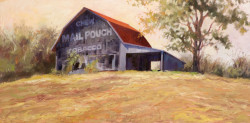
Charles Hopf Mail Pouch Barn_Martin Co_smlfile_Gwen Gutwein

Charles Hopf Mail Pouch Barn in Martin County, IN. Painting by Gwen Gutwein

What is a barn?  For me a barn houses cattle and horses or stores grain, hay and straw, or is  dedicated to tobacco or hops drying.  Most of us think of barns as massive gambrel or gable structures to house livestock in winter.  I do not include pole structures as barns when I think of preservation!  I do believe that urban carriage houses that once contained a family’s buggy horse and milk cow and are often highly refined Victorian structures, do qualify as barns.

What is America’s barn population?  There is no authoritative number even if all questionnaire respondents were to use a uniform definition for a barn.  A 2007 USDA census of farmers and ranchers with more than $1,000 of farm income asked if they owned a barn built before 1960 (this would’ve excluded most pole structures).  The results indicated 650,000 barns, however it excluded multiple barns on the same property, barns no longer located on farms, barns owned by non-farming landlords, and did not consider the condition of the barn.  Fifteen percent of the questionnaires were not returned.

Allowing for the shortcomings mentioned above, Texas registered 51,000 barns, Missouri 36,000, Wisconsin 35,000, Kentucky 35,000 and Iowa 34,000.  In terms of density per square mile it was Kentucky, Ohio, Tennessee, Pennsylvania and Wisconsin.  Michigan was 13th in barn population with 21,368 and 14th in barn density at an average of one for every three square miles.

I find the USDA results unsatisfying given the barns excluded and lack of a uniform definition. Let me approach this question using U.S. census figures.  There were 2.04 million farms at the advent of the Civil War in 1860 to a high of 6.5 million in 1920.  Farms declined to 3.7 million in 1960 and 2.17 million in 2010.  Assuming there is a pre-1960 barn, no matter the condition, on 75 % of the 2010 farms, I would guesstimate 1.5 million barns currently exist on farms.

Note that urban carriage houses or barns no longer on farms are excluded in the 1.5 million, and I believe they are a sizable number.  The problem is that a good proportion of my 1.5 million barns on farms are in such a deteriorated condition that their eventual demise is certain.

I took a last approach, interesting but not statistically correct, and reviewed the barns I can recall since 1950 on 3-miles of Keefer Hwy., Portland where our family’s Centennial Farm is located.  In 1950 there were 12-barns of which 6-7 sheltered livestock and two of these were dairies.

Currently there are six barns—none in active farm use.  I believe based on their condition that four will remain in 2030.  So, 80-years after 1950 only one-third of this barn sample will exist.

I consider 1950 the “High Water Mark” of barn population.  Probably most barns on the 6.5 million farms in 1920 still existed in 1950 and relatively few barns were built in the 25-year period after the farm depression of the early 1920s, the Great Depression of 1929 and the scarcities of WWII.  My opinion is that six million barns existed in 1950, whether located on farms or not. Today, 62-years past the “High Water Mark”, I’d offer for your consideration that approximately two-thirds of the 1950 barns are either gone or going down.

In conclusion I guesstimate that 1.5-2.0 million of pre-1960 barns in all locations exist today in a fair to good condition.  That is the barn universe that we preservationists are attempting to save.  2050 is only 38-years in the future, what percentage of barns will remain a century after the “High Water Mark”?  They say, “Those that gaze at crystal balls to divine the future will be condemned to eat glass”.  Nevertheless I’ll venture that 20 % of the 1950 barns or 1.2 million will remain in a condition ranging from excellent to decrepit.

The romantic in me considers a barn as a trophy or heritage building whilst for others it’s a “money pit” requiring too many squares of shingles or gallons of paint.  My hope is that “scarcity makes the heart grow fonder“and barns in 2050 like covered bridges today will be generally revered.

Restore Oregon Holds Inaugural ‘Sustaining Heritage Barns’ Workshop

This post submitted by NBA Board Member and Secretary, Gina Drew, of Oregon.  In addition to her work with the NBA, Gina chairs Restore Oregon’s Heritage Barn Taskforce, studies timber-framing construction methods, and restores architectural elements. 

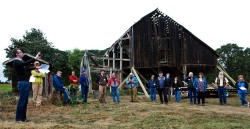
Workshop participants at the Knotts-Owens barn. Photo credit Drew Nasto

Workshop participants at the Knotts-Owens barn. Photo credit: Drew Nasto

September was a very exciting month for those involved in barn preservation efforts across the state of Oregon.  Restore Oregon’s Heritage Barn Taskforce held their first ever inaugural ‘Sustaining Heritage Barns’ Workshop, and it was a resounding sold-out success!  This is so inspiring because it underscores what those of us in the state passionate about preserving barns and other structures within our rural agricultural landscape already knew – that despite Oregon’s having previously lagged behind the rest of the country with respect to a unified presence on the barn advocacy scene – there remains a strong, healthy and vibrant community of people who care about maintaining these remarkable historic icons.  Registration was open to all, and the participant base formed a diverse group of barn owners and enthusiasts as well as those in the field of historic preservation and others in city planning. 

City Planner Jacqueline Rochefort receiving broad axe instruction from David Rogers during hewing demonstration. Phtot credit Gina Drew

City Planner Jacqueline Rochefort receiving broad axe instruction from David Rogers during hewing demonstration. Photo credit: Gina Drew

The workshop was a two-part day long event that was divided into a morning session of visual presentations and an afternoon full of hands-on demonstrations and barn condition evaluations.  The first half of the day was held at the repurposed Walnut Barn, owned by the City of Corvallis Parks and Recreation Department, which is now used as a community rental event space.  The afternoon was spent at the 1870’s Knotts-Owens farm barn, recently listed on Restore Oregon’s Most Endangered Places List for 2013.   The historic farmstead and barn are situated within 312 acres of agricultural land, hardwood forest and wetlands.  The property was purchased by a joint partnership of the City of Corvallis, Greenbelt Land Trust and Samaritan Health Services, and will become part of the city’s open space program and trails network.  The farm and barn are key elements of the future Conceptual Plan, which may include creating ‘living history’ demonstrations of historic agricultural practices and other educational heritage programming via interpretive stations woven along the site.  The workshop helped raise the awareness and importance of barn preservation efforts while applauding the strategic collaborative efforts of the organizations involved in promoting the conservation of our rural architectural resources.

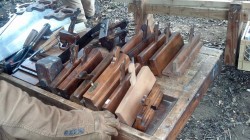
Michael Houser, State Architectural Historian for the Washington Department of Archeology and Historic Preservation, was on hand to provide insight regarding Washington’s successful Heritage Barn Registry model as well as discuss an overview of NW barn typology.  A representative of the Oregon SHPO also covered information on federal and state rehabilitation tax credits.  Attendees were delighted to have an opportunity to roll up their sleeves and try their hand at swinging a broad axe during the demonstration on hand hewing timbers.  A wide variety of historic hand tools and planes were used to explain traditional methods of carpentry and window joinery.  The present structural condition of the barn was studied and assessment principles on how to approach a barn restoration/reconstruction project were identified.

Historic hand tools and plane demonstrations. Photo credit: Gina Drew

Historic hand tools and plane demonstrations. Photo credit: Gina Drew

The Heritage Barn Taskforce looks forward to supporting more workshops, tours and events that will engage and educate the public on the critically important role that barn preservation plays in nurturing the livelihood of our statewide rural historic resources.

Have you met Barny from Kansas?!?

Barny is the most colorful member of the Kansas Barn Alliance (KBA), and he is on the move!  You might have seen him already at a KBA workshop, or spotted him investigating historic barns in advance of repair work… Barny likes to strut his stuff around every barn he sees, but he appears to prefer the historic ones – we at the NBA suffer from a similar condition.

Brokesh Barn 3

Pictured: Brad, and his son, Kolbe, Holmsten from West Chester, PA; Russ Holmsten from Daytona Beach, FL; family friend, Andy Brown from Overland Park, KS, and Barny, of course!

Earlier this summer Barny dropped by the barn-repair crew at the Brokesh Barn in Republic County, Kansas.  This barn restoration is truly a family effort with determined kin travelling from as far as way as Florida and Pennsylvania!  The rest of the remarkable story will be in the next Kansas Barn Alliance newsletter, The Rural Icon.

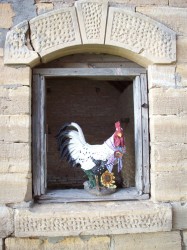
He recently found himself on the window sill of a stone barn at the Hanson farmstead in Cloud County, Kansas, where this 20’x30′ limestone building will be tuck-pointed and have windows & doors installed, so Barny took advantage of the photo opportunity!

Hanson stone building 9.2.13

Barny at the Hanson farmstead in Cloud County.

This incredibly photogenic rooster has been charming his way into many barn and farm events as of late.  Word has it that Barny got the Early Bird Discount and is already registered for the KBA’s BarnFest’13, a two-day conference on October 4th and 5th in Marion County (for further details, visit www.kansasbarnalliance.org).

Barny also plans to attend the Mother Earth News Fair in Lawrence, Kansas, on October 12th and 13th.  The KBA will have a booth there to share information on barn preservation and reuse, and Barny will be on hand to take your questions and pose for pictures with all his barn fans!

It’s true what they say, “Life is never dull in the world of Kansas barns!”  The NBA would sincerely like to thank Susie Haver for sharing updates on all of Barny’s latest adventures, and the wonderful group of Kansans in the KBA hard at work supporting barn preservation in their state!  

Many Firsts at MBPN’s Fall Barn Tour

The information for this post was submitted by NBA member and architect, Charles Bultman.  Charles has been hard at work organizing the MBPN’s Fall Tour for the past several months.  This tour is a first for this region of Michigan and the first barn tour – in the country, as far as we know – to offer Continuing Education credits from the American Institute of Architects (AIA)!
 
Braun barn

Braun barn

The Michigan Barn Preservation Network’s (MBPN) Fall Barn Tour will highlight at least eight historic barns and farmsteads in Washtenaw County: home of Ann Arbor and the surrounding communities of Chelsea, Clinton, Dexter, Saline, and Ypsilanti.   The tour will be on Saturday, September 21st, starting at 8:00 am from the south side of Ann Arbor and will last all day. Participants will receive a guide book that will include a map and photos of all of the barns on the tour, as well as some historical information about each barn.

 Parker barn, interior

Parker barn, interior

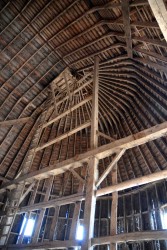
One of the barns featured on this tour was built in 1826 and is certainly one of the oldest barns in the county.  Another shining star is the circa-1920s Parker Barn: a 178 -foot long and 60-foot wide monumental barn with a 30-by-50-foot working granary to boot!   In all, it is a very nice sampling of barns and farm buildings that illustrate a range of approaches to barns spanning nearly 100 years in Washtenaw County.

Further setting this tour apart is a special dinner on Friday night, September 20th, for those who want to enjoy a farm-to-table meal and a lively conversation about barns in Ann Arbor at Zingerman’s restaurant.  The barn tour also qualifies for AIA Continuing Education credits.  More information on these matters is available upon request.

Rentschler barn

Rentschler barn

For MBPN members, the tour is $60 for the day. The cost for non-members is $90. The tour cost—which allows you to tour all nine barn sites with the group—includes the bus and driver, lunch by Zingerman’s, the guide to the barns on the tour, and bottled water and a snack on the bus. The tour is limited to 54 people, so please reserve your seat early to insure that you will get to tour this impressive collection of barns. Secure PayPal for tour reservations is available on the MBPN website.


Now Showing: A New England Barn Model!

DSCF2012

Last winter the NBA was contacted by Tom Musco, a fellow barn-enthusiast and timber framer who was interested in making a barn model that embodied building traditions of New England barns.  Past President, Charles Leik, corresponded regularly with Musco, and members of the Board met this crafty go-getter at the CT Trust’s “Celebration of Barns” last month, just as he was booking the model’s first raisings.

Supplying every bit of the materials, time, and skill involved in construction, Musco based his model on typical English barn dimensions (30’ x 40’) found in the region.  “The model is also based on the research I did when I built the Job Lane barn in Bedford, MA…. a scaled-down reproduction of the barn that was on the site of the Job Lane Homestead.  The original [c. early 1700s] house is still standing and the Town of Bedford and the Friends of the Job Lane House wanted a barn for the house.”

DSCF2085

Tom Musco is a jack of all trades, but has a great deal of experience in timber-frame construction.  When he read about the NBA’s Teamwork & Timbers program, Musco was inspired to create a model to reflect historic New England barns, “…being the husband of a school principal and someone who home-schooled his two children, [I] wanted kids in New England to have the fun of raising a barn frame.” And he has certainly been putting his model to good use!  This summer, Musco has booked a handful of barn raisings, teaching children and adults alike about the region’s rural icons. “What makes the English barn unique and gives it its name is the English Tying Joint at the top of the posts.  This style barn was in use since about 1200 in England and was brought to New England by the English settlers. It was built in New England until the 1850s.”

Tom Musco and his team will be raising the model at the Royalston town library in Royalston, MA, on July 18th, and again at the Timber Framers Guild conference in Burlington, VT, on August 10th.

DSCF1912