Artist Documents Diversity in Barns of Indiana

Excerpts of this story come to us from our partners in barn preservation at the Indiana Barn Foundation and details the work of a long-time NBA member and barn advocate, painter Gwen Gutwein.  Over the years, Gwen has graciously allowed the NBA to add interest to a number of articles and social media posts with beautiful paintings.  Therefore it gives us great pleasure to share her story and talent with barn lovers the world over! **Copyright Gwen Gutwein and HERITAGE BARNS. Any reproduction of these images without written permission of the content creator is prohibited.** 
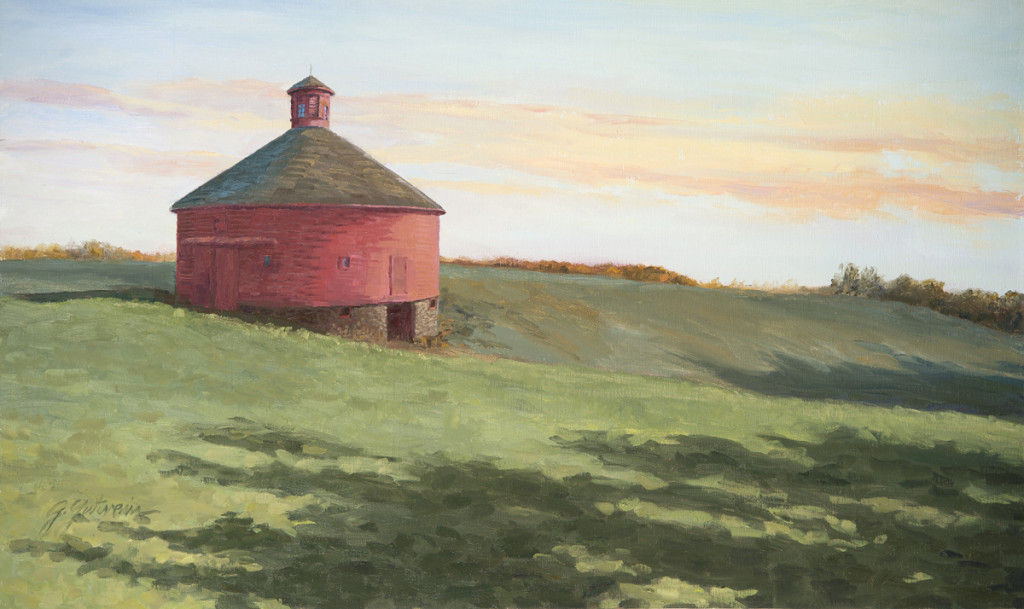
Parke County: THOMPSON-HELEN JO WHITED ROUND BARN

Parke County: THOMPSON-HELEN JO WHITED ROUND BARN (Built between 1888-1891, brick foundation and horizontal siding)

In December 2015, Gwen Gutwein made her final trek–searching out distinctive and historic Indiana barns.

Exhibits of Gwen Gutwein’s barn paintings and histories have been touring the state of Indiana since 2009, but her barn-painting project trademarked HERITAGE BARNS started more than eleven years ago in the fall of 2004.  And it all began with a lofty and time-consuming goal: to research, study, and paint two historic barns from each of Indiana’s 92 counties.
Orange County-BOWEN FAMILY BARN (One of the oldest and most unique in the state, possibly a hay press barn)

Orange County-BOWEN FAMILY BARN (One of the oldest and most unique in the state, possibly a hay press barn)

When asked about the project’s purpose and her own motivations, answers come easily.

“Over the years I have seen so many barns disappear.  With each barn we have lost so much. The old barns are very beautiful, literally and figuratively speaking.  Literally, 100 or 150 years ago the materials used to build a barn are almost non-existent today.  The size and length of some of the timbers is extraordinary. Many old barns were built with our native timber!  The skills used back then are unique, ingenious and quite astounding.

The time and skill used to decorate barns must have given such great satisfaction to the barn owner.  Over the years, their barns have graced our countryside with their unique beauty.  And then there is the beauty expressed through time that becomes an integral part of the structure itself, such as the family history, the cultural history, the farmers’ integrity and the farming ingenuity. 

Certainly too, I was able to practice my art of painting.  Each painting is a portrait, a barn portrait.  So, like capturing people on the canvas, capturing the essence of each barn’s character was of the utmost importance.”
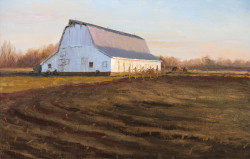
Sullivan County-DRAKE FAMILY BARN (Built in 1936 with oak and walnut harvested on the farm)

Sullivan County-DRAKE FAMILY BARN (Built in 1936 with oak and walnut harvested on the farm)

To say that this project was a labor of love undercuts just how much work it included.

“Gutwein has a distinct process for completing this extensive project.  She begins with detailed research on each county, through which she selects specific historical barns.  After making contact with each barn owner, she obtains consent to begin the painting process at their location.  Gutwein paints en plein air (or outdoors) for several days to capture the correct lighting, color, mood, and character of each barn.  Measurements, statistics, and stories are also gathered while on site.  From there, Gutwein utilizes photography to record every detail of the barn, from which she can paint in her studio.  Until Gutwein feels the project is complete, none of the barn paintings will be for sale.  She finds the whole project is greater than its parts” (Fort Wayne Museum of  Art).
gwen-logoHer HERITAGE BARNS series of paintings, all 185 (one extra) have been endorsed by the Indiana Bicentennial Commission. Beyond exhibits, Gwen has promoted barns and preservation through interviews, newspaper articles,  “barn talks” and more.  Currently, the Columbus Indiana Visitors Center is hosting an exhibit, installed through the end of 2016. 

To learn more about the HERITAGE BARNS project, see the barns she has painted from each of Indiana’s 92 counties, and discover some of the barn stories she has collected, just visit Gwen’s website and watch the video below to check out her studio!
 

The Heart of the Barn

This guest post comes to us from Daniel Dibner, one of the masterminds (or shoudl we say angels?!?) behind “Hay Trolley Heaven.”  To learn more, visit www.haytrolleyheaven.com!

trolley 2


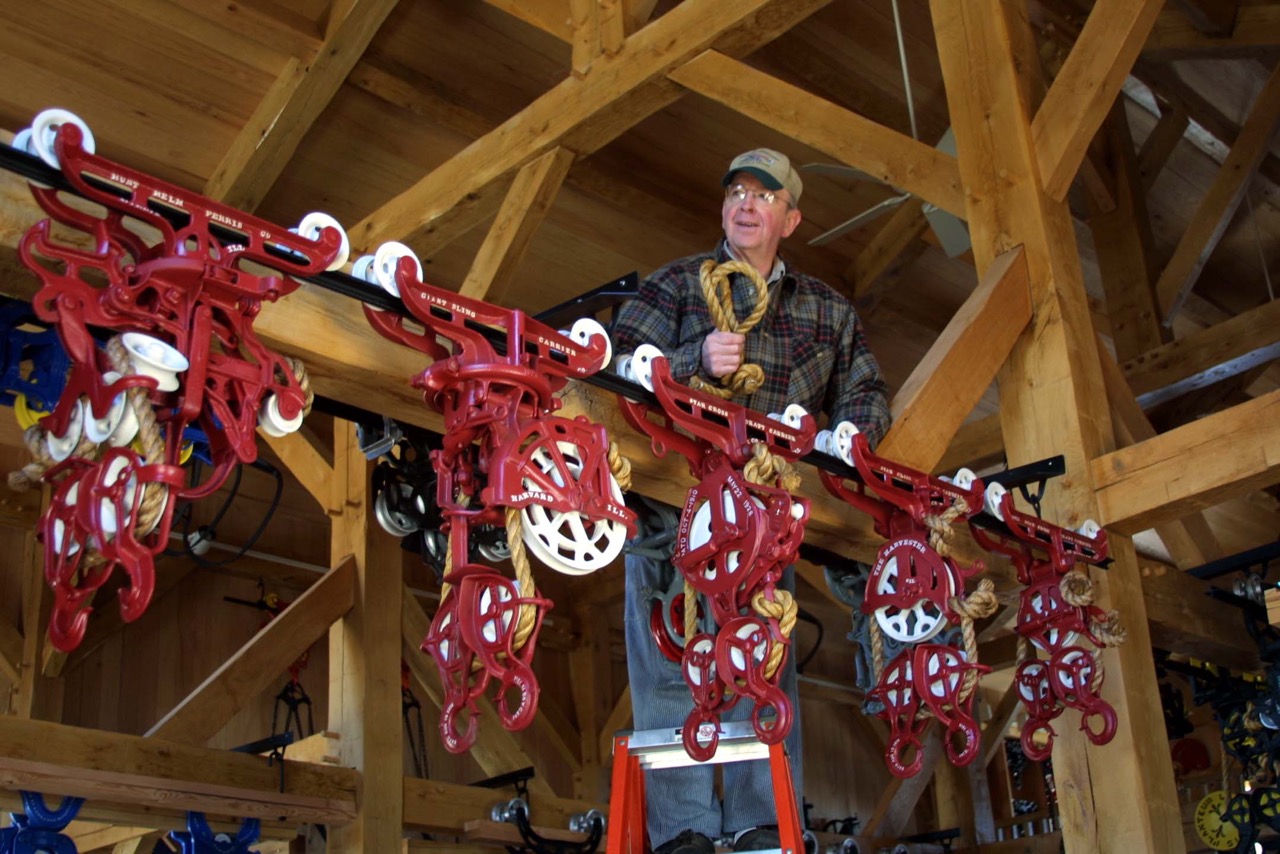
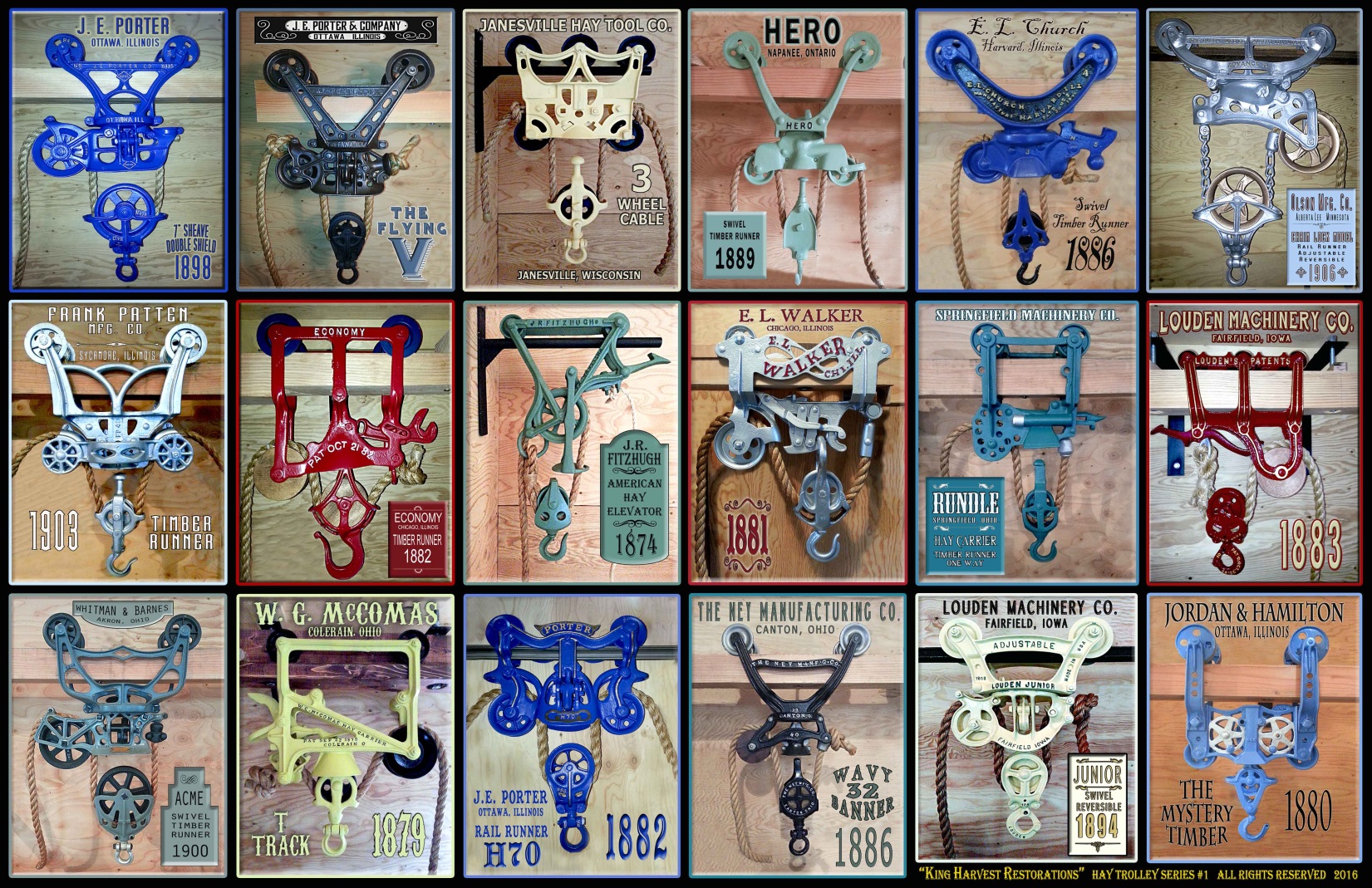
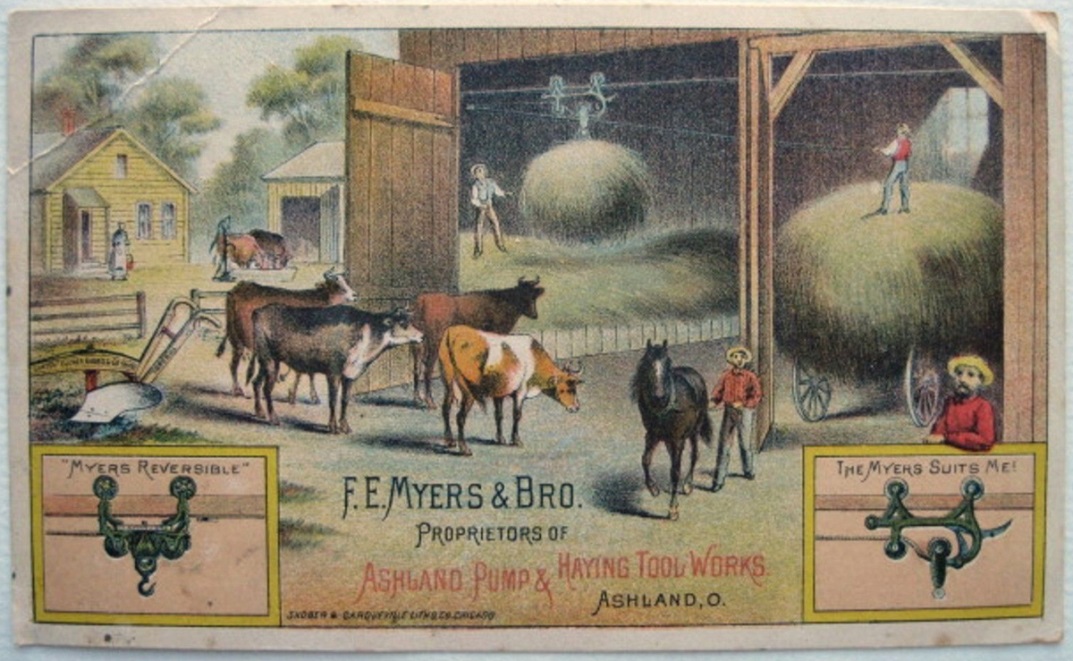
“The Heart of the Barn” is what hay unloaders or hay trolleys have come to be called for well over a 100 years. I am sure that the readers of the Barn Alliance are quite familiar with these iron wonders, as many still are found directly overhead in the older barns. These remarkable pieces of early barn equipment greatly influenced the majority of the barn designs that we see from the 1870’s to around 1930. If one was a practitioner of “modern” farm techniques, one built their barn from plans provided by one of the many manufacturers of trolleys. Prominent manufacturers included the likes of  F. E. Myers, J. E. Porter, Louden, Ney and Hunt, Helm & Ferris, all providing (in many cases free of charge) the architectural plans needed to build the period’s most efficient means of moving  hay and other crops around,  namely the hay trolley. Farmers either built for timber or steel track systems or were left to lift tons of material into the mow by hand. This was all loose hay technology and it all essentially ends with roll-up baling.

trolley 1

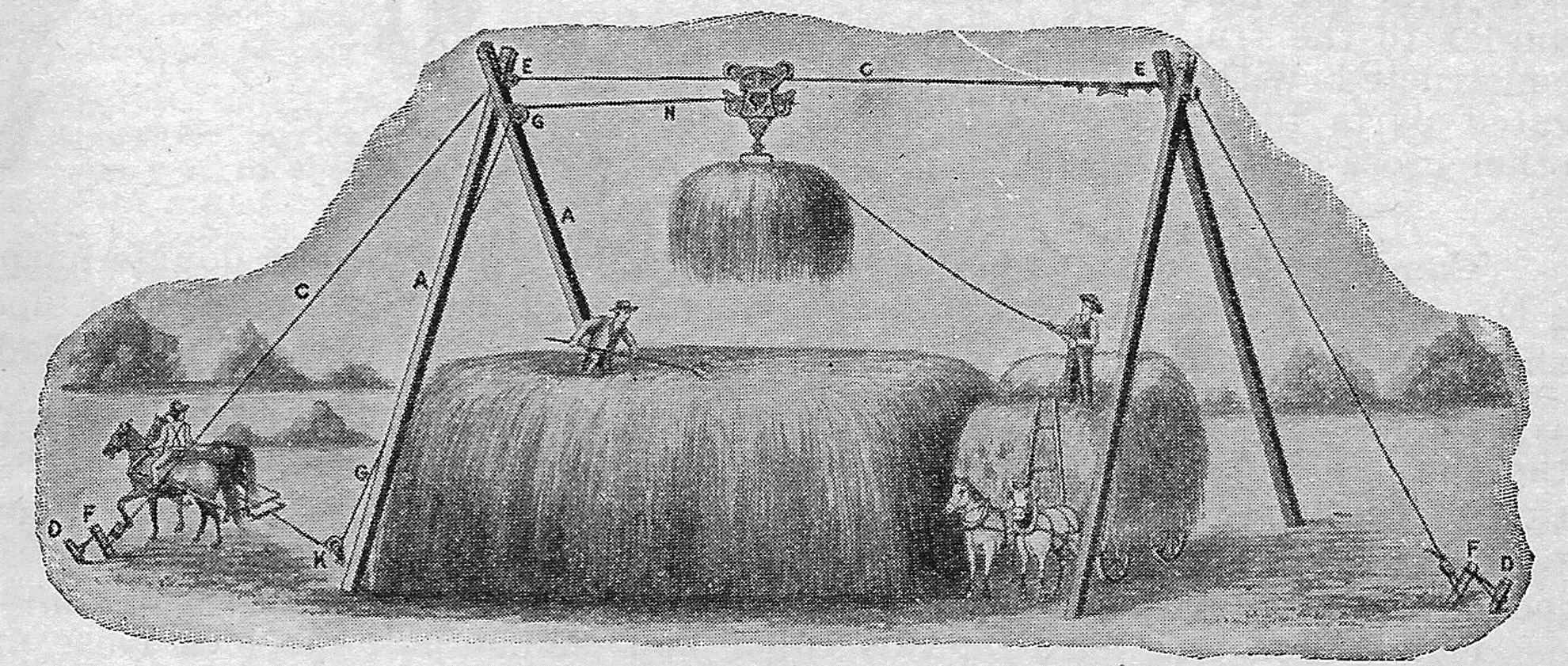
Fewer people are aware that even before barns were built to store the mow, hay trolleys were hard at work in the fields. Systems of cables were strung up and America’s countryside was the home to massive hay stacks that were unmatched in size. Trolleys finally were brought into use in barns as modifications were made to move huge amounts of hay within the structures. How the hay wagons approached the barn, at the end or center, made a great deal of difference in the overall design of these iron wonders.

trolley 3


We here at HAYTROLLEYHEAVEN.COM are dedicated to the preservation, cataloging, collection and display of all things related to hay trolleys. When Danae Peckler of the Barn Alliance stumbled on to our website, she reached out to me to ask if our site could be mentioned in your newsletter. The answer was, of course, absolutely!  You love barns, we love barns. Our world is an astonishing mix of what is unquestionably the start of something remarkable.

The amount of patents, from trolleys, to forks, to hay slings, to door rollers and much more, all comes from the ever present advancements made during the late 1880’s. All of this was to allow the American farmer to make the great leap forward through technology and efficiencies found in engineering and industry. We believe that these devices represent some of the earliest programmable machines on the farm. Special trips and stops directed these devices to hold or release on the track, drop their center drop pulley or retain them. There were round barn systems, track switch arrangements and a whole host of lifting techniques that changed life on the farm forever.

trolley 4


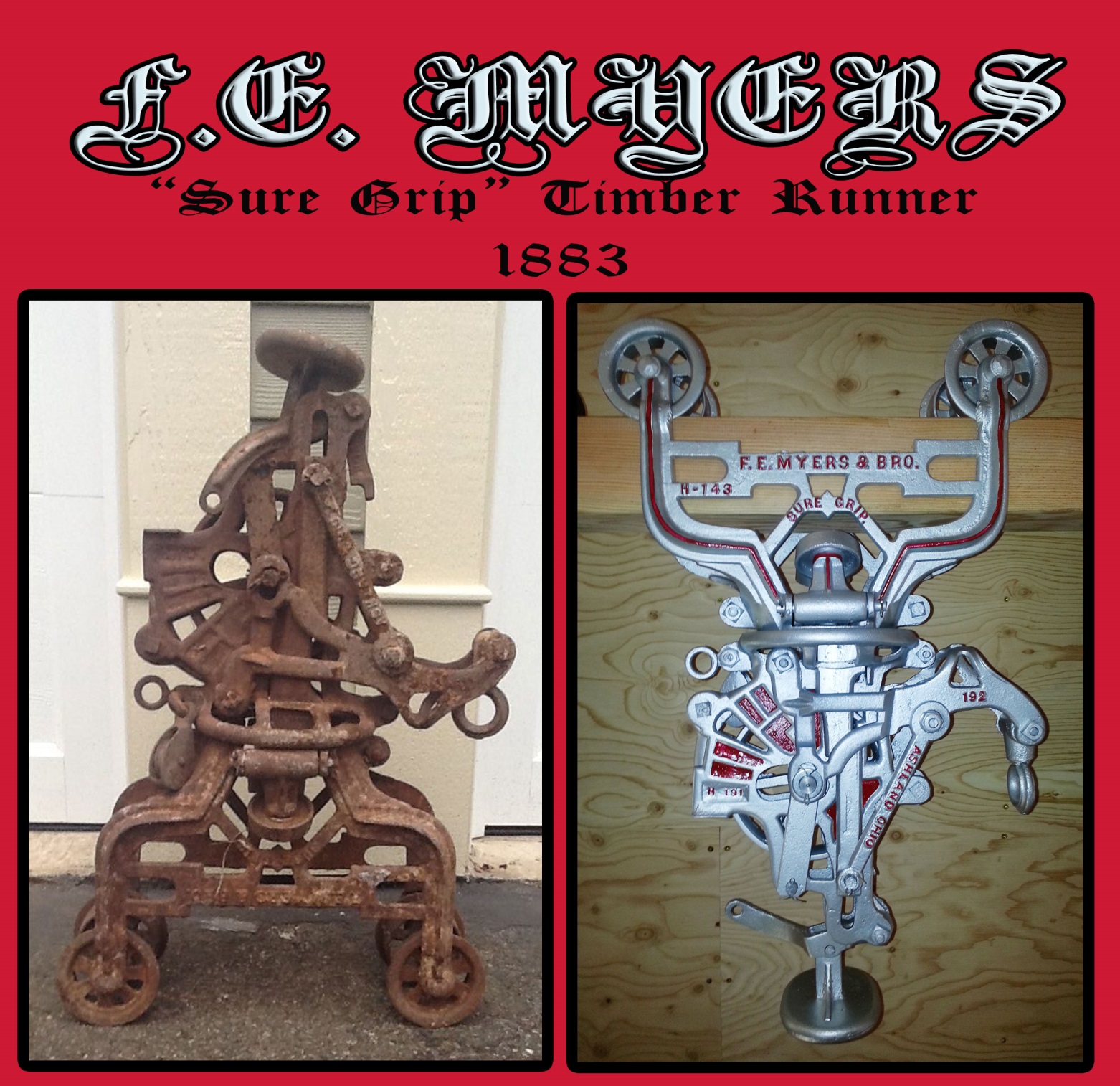
During the metal drives of World War I and II, much of the old metal was removed from the farm. But, as there were few patriots that would risk life and limb to climb up some 40 feet to bring down a 50 pound trolley all while balancing on then wooden ladders, they are there to be found. We at haytrolleyheaven.com discover new wonders almost every week.

When you come to visit haytrolleyheaven.com you will see the largest cataloging of hay trolleys ever assembled online. The vast majority of Manufacturers, models, advertisements, patents, collection, etc. are presented for the members. There is an active forum that members participate in that gets questions answered, shares pictures of trolleys, restoration tips and a whole lot more. Start with the tabs on the homepage and work your way through the whole website. It is broad and deep and rich with information and data for the beginner to the expert.  We have past editions of our own newsletter available online for downloading as well.

We hope that you will take the time to determine if your barn restoration should include the “Heart of the Barn” if there is an indication that one existed there. With literally 100’s upon 100’s of models being attended to by our membership, we stand ready to assist as required.  Contact us at “admin_1@haytrolleyheaven.com” (must have the “underline” between admin and 1) if you have problems creating log in credentials or have general questions.

trolley 5

Dating Barns in Holland Township, NJ with Dendrochronology, Part 2

Dating Barns in Holland Township, New Jersey with Dendrochronology Part 2 – The Results

by Carla Cielo, Architectural Historian, Historic Preservation Consultant, Designer

This is the second article that Ms. Cielo has written on the subject of dendrochronology in Holland Township, NJ.  Read the first one by clicking here!

Image Courtesy of Mr. and Mrs. Wydner

Image Courtesy of Mr. and Mrs. Wydner

The Historic Preservation Commission of Holland Township, New Jersey, hired Oxford Tree-Ring Laboratory to date nine barns with dendrochrolology. This study has been funded in part with grants provided by the New Jersey Historical Commission. It was hoped that a study of this kind would answer questions related to ethnic settlement patterns.

Holland Township borders the Delaware River and Upper Bucks County Pennsylvania to the west and south, the Musconetcong River and Warren County to the north and Alexandria Township and Milford in Hunterdon to the south and east. This location facilitated easterly migration from Bucks County, Pennsylvania. The barns chosen for the study were considered to be among the oldest remaining barns of their type in the township. An approximate construction date for each barn (based on the style of framing, presence of hewn and/or sawn timbers, the types of nails used in original materials and various other construction details) was determined prior to the study.

Two major barn types remain in the township:

  • The ground-level, swing beam barn is a single-level, side entry barn with three or four bays which typically includes a central threshing floor, haymow(s) and a bay to stable livestock with a hay loft above the stables. The smallest ground level three bay barn is 20’ wide x 31’ long, but 24’ to 26’ wide x 36’ to 38’ long is more common. The ground level four bay barns are about 26’ wide x 48’ long.
  • The Standard Pennsylvania Forebay bank barn is a larger, two-level barn built into a bank for convenient access to the haymows in the upper level. The stables are in the lower level. The dated forebay barns measure 35’ wide x 55’ long; 32’ wide x 50’ long; and 30’ wide x 50’ long.

The results of the dendrochrolology study are both exciting and disappointing at the same time; some questions were answered but others remain undetermined. Six ground-level, (three and four bay) swing beam, frame barns revealed the following construction dates: 1794, 1794, 1803, 1806, 1809 and 1812. Note: a 7th ground level barn dated 1787 was eliminated from the conclusion because the date was derived solely from three samples taken from floor joists. The upper framing was not sampled and suggests a later date when compared to the other dated barns. Additional samples may be taken at a later date.

Conclusion – ground barns: The 1790s were the wild west of Holland Township. This was when the tenant farms, which had been leased by an absentee British landowner, were opened for private sale. The results of the dendro study indicate that all of the dated barns, were built after the associated farm had been sold and suggest that these barns were built as an improvement (or as an addition) to the earlier tenant barns. Note: The barn that was eliminated from the conclusion is located on a farm which did not sell until 1813, but since it post dates the Revolutionary War was likely built by the tenant (not the landowner) as an improvement to an earlier barn.

We know that the tenant barns were frame (not log or stone) and that they were built by the British landowners for the tenants from an “account of the expenses of building a barn on the place leased to John Thomson” which includes the purchase of “2000 feet of weatherboards,” “15 days work …. cutting and hauling timbers,” “55 days board,” “32 meals at raising,” “3 gallons rum,” “blacksmith work for hinges and nails,” “work of carpenters £12.0.0,” “masons work,” “2000 Shingles,” etc. The question remains, what did the circa 1750 to 1776 tenant barn look like? Nothing has been identified from this period as of yet.

The dendro study revealed that the earliest remaining barns were built entirely of hewn timbers and the rafter plates have double notched rafter seats. The earliest barn to be framed with single notched rafter seats dates to 1794 but there is an overlap; the other 1794 barn has double notched rafter seats. This indicates that framing details had begun to be simplified by 1794. The use of sawn braces and studs occurred by 1803 and the use of sawn rafters occurred by 1812.

Three Pennsylvania Forebay bank barns revealed the following dates: 1806 (stone), 1821 (frame) and 1825 (frame).

Conclusion – Pennsylvania Forebay barns: According to a late 19th century account, in 1806, Phillip Burgestresser (1778-1841) who was of German ancestory, moved to Holland Township from Tinicum Township in Bucks County, Pennsylvania and built a “nice brick house and good barn far superior to that of his neighbors.” This quote suggests that the “far superior” barn was a Pennsylvania Forebay bank barn and that this barn type first appeared in Holland Township in or slightly after 1806. The date of 1806 for the earliest remaining stone Pennsylvania forebay barn supports this conclusion. (Note: Barn historians formerly assigned a circa 1820 to 1825 date for the migration of the Pennsylvania Forebay barn form into Northwest Central New Jersey). The Pennsylvania Forebay barn type migrated into this area of New Jersey from upper Bucks County, Pennsylvania. That study also shows that a much lighter style of timber framing migrated along with the forebay barn form.

Settlement from Upper Bucks County into Holland Township began by about 1750 or earlier. Early communication between Upper Bucks County and Holland Township was facilitated by the presence of a ferry by 1741 and the transportation of iron related resources to and from Durham Furnace which began production in 1727. The fact that the Pennsylvania forebay barn type did not appear in Holland Township until the first decade of the 19th century suggests that the barn type did not reach upper Bucks County until the first decade of the 19th century. However, the Federal Direct Tax of 1792, lists a “35’ x 60’ stone barn” in Durham Township, and a “30’ x 50’ stone barn” in the neighboring Township of Nockamixon which suggests the presence of the larger forebay barn type in Upper Bucks County by the end of the 18th century (further research in Bucks County is required). If this was the case, what delayed the form from crossing the river when communication and transportation was so prevalent?

What’s next?

The dendro study shows that both the smaller ground barn and the much larger Pennsylvania Forebay bank barns were built concurrently for awhile. It would be nice to accurately date a few of the younger ground barns to see how long the smaller barn type persisted.

Reused components remain in several reconstructed barns and are sometimes in an addition to a ground barn. These include rafter plates with double notched rafter seats, posts with a flair at one end reused as a plate, as well as whole sections of reused framing. These fragments may be dendro dated in the future with the hopes of finding some evidence of the type of barn construction during the 1750 to 1776 tenant period.

NBA Partners with Belmont College for 2016 Spring Meeting in Ohio

National Barn Alliance’s 2016 Spring Meeting to be Hosted by Preservation Program at Belmont College in Ohio!

The National Barn Alliance (NBA), whose mission is to protect and preserve America’s historic barns and rural heritage, is partnering with the Building Preservation/Restoration (BPR) Program at Belmont College to offer a unique glimpse into the physical labor and craftsmanship behind saving our barns. The Spring Meeting will be held at Belmont College in St. Clairsville, Ohio, from April 8-10, 2016. BPR Program students will be leading hands-on demonstrations during the conference.  The meeting is open to NBA members, but registration is required as available space is limited.

The NBA is pleased to make this connection with one of the country’s leading hands-on preservation training programs, led by Program Coordinator, David Mertz, since 1989.  Mr. Mertz also serves on the Board of the Preservation Trades Network (PTN)—an organization that the NBA is partnering with again for their annual conference later in the year.  The NBA holds an open Board Meeting focused on the organization’s major initiatives and bottom line each year which also seeks to introduce the organization to a new group of Preservation students at institutes of higher learning. In 2013, this event was held in conjunction with the Department of Historic Preservation at the University of Mary Washington in Fredericksburg, Virginia, and, after a failed attempt due to a snow storm in 2014, with the Historic Preservation Program at Bucks County Community College in Newtown, Pennsylvania, in 2015.

Danae Peckler, NBA Board member and Past President, is excited for this year’s meeting at Belmont and the hands-on learning experience that it will provide.  “Education, networking, and the physical act of preservation are three of the four tenets in our mission, so this meeting really hits at the core of what we seek to do as an organization,” she observed.  “We are thrilled to be hosted by Belmont College and the talented students in its renowned preservation trades program.”

The NBA anticipates a number of representatives from its organizational allies and other preservation groups will also be in attendance. “Our Spring Meeting will be held just two weeks before the Friends of Ohio Barns’ 17th annual conference in Butler County, so together, we hope to increase awareness and support for barn preservation in the state, at large,” said current NBA President, Don Truax. “We want people to realize that historic farms and barns embody the built record of everyone’s story – and our story is worth the fight.”

If you are interested in attending the NBA’s Spring Meeting at Belmont College in St. Clairsville, Ohio, April 9-10, or want to learn more about this great event, please contact info@barnalliance.org. Space will be limited, so please remember to register early.  NBA Membership forms can also be downloaded from their website here: https://www.barnalliance.org/join-us/.


NBA’s 2015 in Review

The National Barn Alliance in 2015 (as faithfully reported by NBA Vice President, Chuck Bultman)

As 2015 draws to a close we, like many, reflect on our past year. But we don’t just do that and send it to you so we can get a pat on the back, or an “attaboy.” No we do it to keep you informed about where we are focusing our efforts as you may have an opinion about what we are, or are not accomplishing. We welcome your feedback. We also do this to add to the conversation about barn preservation in the hopes that you will be talking about it with your friends and colleagues and possibly get them involved and contributing as well. As you know well this is an important and rewarding activity and we can use all of the help we can get.

What you may not know so well is your NBA Board is made up of volunteers all across the country, all of which are very involved with the state and local preservation efforts where we live, as well as the local organizations that are championing those efforts. We are all knowledgeable about the barns in our respective states, as well as those in some of the surrounding states. As such, when we do talk as a board (which we do monthly) and when we meet in person (which we try to do twice a year) we share our experiences and knowledge that comes from our region. In short, we learn from each other.

It is in that spirit of sharing that we write this article today. And it is that spirit of sharing that the board of the National Barn Alliance commits itself. The NBA continues its commitment to act as a facilitator for people across the country who are interested in saving the barns where they live. We do that by sharing the information we know and have gathered from barn preservationists across the country for many years. We also put people in touch with local and/or national experts to help them with their preservation efforts… much can be accomplished from anywhere in the country.

So in that spirit of sharing last summer the NBA board decided to ‘share’ our annual conference with the newly formed Indiana Barn Foundation at their summer conference; this was just the second year the IBF held a conference. Seven board members made the trip to Indianapolis for three days and participated in a spirited conference of about 75 attendees. It was a well attended and high-energy conference and we met so many nice Hoosiers who have kept in touch over the last six months; we are now resources for each other.

And while we were in Indianapolis, three of us stopped by the Indiana American Institute of Architects‘ office the day before the conference to talk with local architects about barn preservation and possible adaptations over lunch. It was a great opportunity to spread the good word about barns to professionals who may not have old timber-framed buildings on their radar. And again we are now each other’s resource.

Sharing can be contagious. Last year the NBA board voted to financially support an effort to make a documentary about Midwest barns. The movie is to be called The Barn Raisers and is being made by filmmakers Kelly and Tammy Rundle of Fourth Wall Films. This film is also being supported by a number of Midwest state barn preservation organizations (OH, MI, KS, IN, IA) as well as humanities councils in those states. But the big deal about this project is that the filmmakers have pulled into the documentary the voices of not only the barn owners but also the many knowledgeable barn preservationists who populate these organizations, including the NBA. The film is due out in late 2016 and we are anxious to see what they make.

Sometimes we share just by showing up. November was the annual conference of the National Trust for Historic Preservation and was in Washington D.C. The organization has maintained a presence at this conference for more than a decade with six NBA board members attending this year’s event. It was a very nice opportunity to reconnect with the many preservationists we know and some we only know from their work or writings. We also connected with leaders from other organizations who are committed to preservation in one way or another, resulting in a number of potential partnerships for years to come! As always, it was a very rewarding experience for the NBA and our growing network of barn preservationists across the country.

2015 also found the NBA sharing with the Timber Framers Guild, which is dedicated to the craft of timber framing as well as educating young carpenters in this ancient art. Past vice-president, Jeff Marshall, helped to organize and host a gathering of timber framers in his barn-rich county in eastern Pennsylvania. This conference included a barn tour as well as a number of presentations, including one by Jeff. NBA Past President Charles Leik also worked with the guild last year as their Treasurer, recently partnering with the organization to build a new timber-framed structure in his Michigan town of Portland.

Charles Leik has also kept us informed on the future of “the Star Barn” outside of Harrisonburg, PA. We at the NBA were also pleased to hear that in 2015 the Star Barn complex, that iconic Victorian barn grouping that found themselves alone on the side of a highway are finally being saved. Attempts to save these icons of agricultural architecture have been in the works for decades, with a number of NBA board members visiting the site and working to spread the word about their plight. And while we recognize that it is a compromise to move these buildings, we are happy that they will still be in eastern Pennsylvania, and that the Keeper of the National Register of Historic Places will continue to recognize them as nationally significant historic buildings.  Other sharing endeavors the 2015 to tell you about include facilitating the saving of one of only four octagonal barns that are believed to exist in Michigan, this barn is in Cadillac.  A team is being assembled to consult with the community and a fund raising effort is being shaped.

Lastly, we would like to point out an absence in our world. Have you ever seen a U. S. postage stamp that illustrates a real barn? Maybe the T.A. Moulton barn in Wyoming; supposedly the most photographed barn in the country. Or the Star Barn, which is a rock star on the east coast. Michigan’s iconic barn is the D. H. Day barn in Glen Arbor. Or even the eastern Tennessee cantilevered barns that inspired the NBA’s most recent tee shirts. Search any of these and many beautiful images appear. However the U. S. Postal service had never published the image of one of these; or any other real barn. As far as we can tell the Postal service has two stamps with ‘likenesses’ of barns; one red and one white. In 2015 we at the NBA have made the case to the Postal Service that it is time to honor barns with stamps like lighthouses and other iconic working buildings have been honored. It is time. That process however is complicated and opaque. We will not know if, or when, the Postal Service will make this happen. But someone had to make the request. And who better than the NBA?

It has been a good year here at the NBA. Spread the word and ask others to join in the barn preservation movement with us.  Historic barns everywhere need our support!