Restore Oregon Holds Inaugural ‘Sustaining Heritage Barns’ Workshop

This post submitted by NBA Board Member and Secretary, Gina Drew, of Oregon.  In addition to her work with the NBA, Gina chairs Restore Oregon’s Heritage Barn Taskforce, studies timber-framing construction methods, and restores architectural elements. 
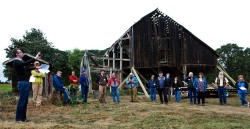
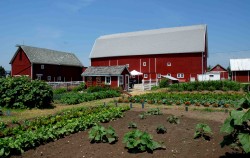
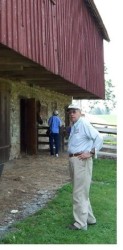
Workshop participants at the Knotts-Owens barn. Photo credit Drew Nasto

Workshop participants at the Knotts-Owens barn. Photo credit: Drew Nasto

September was a very exciting month for those involved in barn preservation efforts across the state of Oregon.  Restore Oregon’s Heritage Barn Taskforce held their first ever inaugural ‘Sustaining Heritage Barns’ Workshop, and it was a resounding sold-out success!  This is so inspiring because it underscores what those of us in the state passionate about preserving barns and other structures within our rural agricultural landscape already knew – that despite Oregon’s having previously lagged behind the rest of the country with respect to a unified presence on the barn advocacy scene – there remains a strong, healthy and vibrant community of people who care about maintaining these remarkable historic icons.  Registration was open to all, and the participant base formed a diverse group of barn owners and enthusiasts as well as those in the field of historic preservation and others in city planning. 

City Planner Jacqueline Rochefort receiving broad axe instruction from David Rogers during hewing demonstration. Phtot credit Gina Drew

City Planner Jacqueline Rochefort receiving broad axe instruction from David Rogers during hewing demonstration. Photo credit: Gina Drew

The workshop was a two-part day long event that was divided into a morning session of visual presentations and an afternoon full of hands-on demonstrations and barn condition evaluations.  The first half of the day was held at the repurposed Walnut Barn, owned by the City of Corvallis Parks and Recreation Department, which is now used as a community rental event space.  The afternoon was spent at the 1870’s Knotts-Owens farm barn, recently listed on Restore Oregon’s Most Endangered Places List for 2013.   The historic farmstead and barn are situated within 312 acres of agricultural land, hardwood forest and wetlands.  The property was purchased by a joint partnership of the City of Corvallis, Greenbelt Land Trust and Samaritan Health Services, and will become part of the city’s open space program and trails network.  The farm and barn are key elements of the future Conceptual Plan, which may include creating ‘living history’ demonstrations of historic agricultural practices and other educational heritage programming via interpretive stations woven along the site.  The workshop helped raise the awareness and importance of barn preservation efforts while applauding the strategic collaborative efforts of the organizations involved in promoting the conservation of our rural architectural resources.

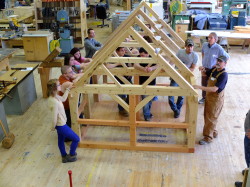
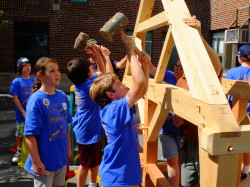
Michael Houser, State Architectural Historian for the Washington Department of Archeology and Historic Preservation, was on hand to provide insight regarding Washington’s successful Heritage Barn Registry model as well as discuss an overview of NW barn typology.  A representative of the Oregon SHPO also covered information on federal and state rehabilitation tax credits.  Attendees were delighted to have an opportunity to roll up their sleeves and try their hand at swinging a broad axe during the demonstration on hand hewing timbers.  A wide variety of historic hand tools and planes were used to explain traditional methods of carpentry and window joinery.  The present structural condition of the barn was studied and assessment principles on how to approach a barn restoration/reconstruction project were identified.
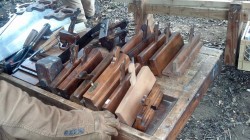
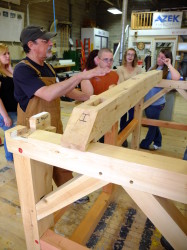
Historic hand tools and plane demonstrations. Photo credit: Gina Drew

Historic hand tools and plane demonstrations. Photo credit: Gina Drew

The Heritage Barn Taskforce looks forward to supporting more workshops, tours and events that will engage and educate the public on the critically important role that barn preservation plays in nurturing the livelihood of our statewide rural historic resources.
Many Firsts at MBPN’s Fall Barn Tour

The information for this post was submitted by NBA member and architect, Charles Bultman.  Charles has been hard at work organizing the MBPN’s Fall Tour for the past several months.  This tour is a first for this region of Michigan and the first barn tour – in the country, as far as we know – to offer Continuing Education credits from the American Institute of Architects (AIA)!
 
Braun barn

Braun barn

The Michigan Barn Preservation Network’s (MBPN) Fall Barn Tour will highlight at least eight historic barns and farmsteads in Washtenaw County: home of Ann Arbor and the surrounding communities of Chelsea, Clinton, Dexter, Saline, and Ypsilanti.   The tour will be on Saturday, September 21st, starting at 8:00 am from the south side of Ann Arbor and will last all day. Participants will receive a guide book that will include a map and photos of all of the barns on the tour, as well as some historical information about each barn.

 Parker barn, interior

Parker barn, interior

One of the barns featured on this tour was built in 1826 and is certainly one of the oldest barns in the county.  Another shining star is the circa-1920s Parker Barn: a 178 -foot long and 60-foot wide monumental barn with a 30-by-50-foot working granary to boot!   In all, it is a very nice sampling of barns and farm buildings that illustrate a range of approaches to barns spanning nearly 100 years in Washtenaw County.

Further setting this tour apart is a special dinner on Friday night, September 20th, for those who want to enjoy a farm-to-table meal and a lively conversation about barns in Ann Arbor at Zingerman’s restaurant.  The barn tour also qualifies for AIA Continuing Education credits.  More information on these matters is available upon request.

Rentschler barn

Rentschler barn

For MBPN members, the tour is $60 for the day. The cost for non-members is $90. The tour cost—which allows you to tour all nine barn sites with the group—includes the bus and driver, lunch by Zingerman’s, the guide to the barns on the tour, and bottled water and a snack on the bus. The tour is limited to 54 people, so please reserve your seat early to insure that you will get to tour this impressive collection of barns. Secure PayPal for tour reservations is available on the MBPN website.


Now Showing: A New England Barn Model!

DSCF2012

Last winter the NBA was contacted by Tom Musco, a fellow barn-enthusiast and timber framer who was interested in making a barn model that embodied building traditions of New England barns.  Past President, Charles Leik, corresponded regularly with Musco, and members of the Board met this crafty go-getter at the CT Trust’s “Celebration of Barns” last month, just as he was booking the model’s first raisings.

Supplying every bit of the materials, time, and skill involved in construction, Musco based his model on typical English barn dimensions (30’ x 40’) found in the region.  “The model is also based on the research I did when I built the Job Lane barn in Bedford, MA…. a scaled-down reproduction of the barn that was on the site of the Job Lane Homestead.  The original [c. early 1700s] house is still standing and the Town of Bedford and the Friends of the Job Lane House wanted a barn for the house.”

DSCF2085

Tom Musco is a jack of all trades, but has a great deal of experience in timber-frame construction.  When he read about the NBA’s Teamwork & Timbers program, Musco was inspired to create a model to reflect historic New England barns, “…being the husband of a school principal and someone who home-schooled his two children, [I] wanted kids in New England to have the fun of raising a barn frame.” And he has certainly been putting his model to good use!  This summer, Musco has booked a handful of barn raisings, teaching children and adults alike about the region’s rural icons. “What makes the English barn unique and gives it its name is the English Tying Joint at the top of the posts.  This style barn was in use since about 1200 in England and was brought to New England by the English settlers. It was built in New England until the 1850s.”

Tom Musco and his team will be raising the model at the Royalston town library in Royalston, MA, on July 18th, and again at the Timber Framers Guild conference in Burlington, VT, on August 10th.

DSCF1912

Saying Goodbye to a Great Friend of Old Barns: Dr. William J. Kimball (1925-2013)

Bill Kimball headshot

William J. Kimball PhD, or Bill as we knew him, recently departed this life at the age of 87 in Lansing, Michigan on May 24, 2013.  He was born on October 6, 1925 to Elmer and Gladys Kimball in Seymour, Wisconsin.

Bill worked for 39 years as a professor at Michigan State University and as an Extension Specialist in community and organizational development. He authored numerous studies on the value of citizen input and action in our communities.

He was a tireless advocate for historic barn preservation and facilitated the creation and growth of many state and local barn groups as well as the National Barn Alliance. Bill was one of just a few Cornerstone members of the NBA and has supported our organization since its earliest days in the mid-1990s.  We will all miss the incredible insight and experience Bill brought to the NBA’s Board of Directors.

Those desiring to contribute in William’s name may do so to the American Heart Association Memorials and Tributes Lockbox, 3816 Paysphere Circle, Chicago, IL 60674 or the Meridian Historical Village, 5151 Marsh Rd., Okemos, MI 48864.

The NBA would also like to encourage those who knew Bill and his work with historic barns to leave thoughts and comments below.   Bill certainly made our community a better place to be… Please help us say goodbye to a great friend of old barns.

A Traditional Marriage: Historic Barns & Beautiful Quilts

This article was submitted by Suzi Parron, author of Barn Quilts and the American Quilt Trail Movement.  We are thrilled to connect with Ms. Parron and others active in the barn quilt movement.  The NBA sees the use of quilt blocks and historic barns  behind them, acting as a canvas, to be an enchanting (and culturally significant!) reflection of men and women’s traditional work on farms across the country.  

The historic barns of Kittitas County, Washington, are receiving quite a bit of attention these days.  Several local barns have been decorated with barn quilts—quilt patterns painted on wood and mounted on the barn surfaces for passersby to see. The effort marks the beginning of the state’s first quilt trail, which encourages visitors to travel the rural countryside and creates renewed appreciation for the area’s barns.  Half of the forty barns that make up the first phase of the trail are more than 100 years old, and the remainder date to the 1960s or earlier.

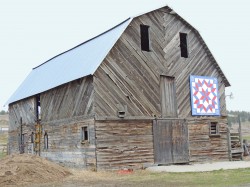
Ballard Barn and Wagon Wheel Quilt Block, Photograph by Jacqueline Fausset

Ballard Barn and “Wagon Wheel” Quilt Block, Photograph by Jacqueline Fausset

One of the most notable is the Ballard barn in Cle Elum, built in 1900 by the original homesteader, Miles Clinton Ballard. Ballard was a skilled carpenter whose barn is unique among those in the area, designed to survive the valley’s spring winds that often gust up to 60 miles per hour. He designed the barn with lateral boards on the first story and diagonal bracing on the upper half.The barn was originally used to store hay and to shelter draft horses and also housed calving cows as needed.  It is still in active use to store hay and farm equipment. Current owner Chuck Ballard is the sixth generation of his family to occupy the farm, which still has all of its original homestead acres intact. The Wagon Wheel quilt block was chosen because it reminded Chuck of the wagons and buggies that were used on the farm when he was a child.  He and wife Bev decided upon a patriotic color scheme to honor their late son Greg, a well-loved and respected firefighter in Cle Elum.

The Barn Quilts of Kittitas County are part of a movement that began with Donna Sue Groves in Adams County, Ohio.  Groves and her mother, Maxine, moved to a farm in 1989 that included a tobacco barn.  The circa 1950 barn, like most built for drying tobacco, was plain in appearance—a very simple gable-entry design. Groves was struck by the idea of adding a painted quilt square above the sliding doors to honor her mother’s renowned quilting and the family’s Appalachian heritage.  When it came time to complete the project, Groves suggested that twenty barn quilts could be painted and placed along a driving trail that would invite visitors to travel through the countryside.  In 2011, an Ohio Star was painted by local artists and installed on a small barn nearby, and the trail of twenty quilt blocks—including one on the Groves barn—was completed over the course of three years. The Ohio Star is one of the most popular barn quilt patterns in its home state and beyond.

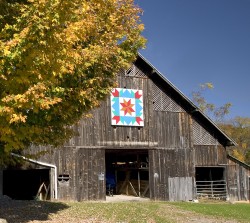
Michael Barn and "Ohio Star" Quilt Block

Michael Barn and “Ohio Star” Quilt Block

The Ohio Star is one of the most popular barn quilt patterns in its home state and beyond.  In Urbana, Ohio, this pattern marks the barn owned by Todd and Jill Michael. The Michaels have owned the property for nearly fifteen years and spent a lot of time researching its history. The 1850 Pennsylvania bank barn and late-19th century, 12-sided addition were present in 1896, when Chauncy Glessner received the farm as a wedding gift from his father.  Each of the 12 sides corresponds to a stall below with an interesting feature—round, polished stanchions. According to Michael, broom handles were manufactured in Urbana and were commonly used in barns nearby.  Restoring the barn was a project for Michael.  The barn’s current appearance belies its age, and the Michaels regularly find visitors pulling up their long driveway to get a closer view of one of Ohio’s treasures.

From its beginnings in Ohio, the barn quilt movement has expanded to 44 states and Canada.  Over 4,000 quilts are part of organized trails; hundreds more are scattered through the countryside, not part of an organized effort.  A drive along the quilt trail appeals to barn enthusiasts and to those who appreciate the iconic quilt patterns.  A quilt trail near her home in Callaway, Kentucky caught the eye of Posy Lough. Lough creates needlework patterns that celebrate American heritage, so barn quilts were a perfect addition to her “Posy Collection.”  The Redwork Quilt Kit features 12 barn quilt patterns from across the country. Included are the Ohio Star, the Snail’s Trail pattern that graces the Groves barn, and an unusual design called LeMoyne with Swallows, which is found on a Century Farm in Johnson City, Tennessee.

Epperson Barn and LeMoyne with Swallows

Epperson Barn and “LeMoyne with Swallows” Quilt Block

LeMoyne with Swallows is a reproduction of a cloth quilt sewed by the grandmother of farm owner Marcella Epperson.  Epperson’s grandparents, Isaac and Barbara, inherited the property acquired by the family in 1848.  Epperson recalls the barnyard in the 1940s and 50s: “There were horses, cows, mules, hogs, chickens, ducks, and guineas–pretty much everything. It was like Old MacDonald’s farm!” The 1898 gable-roofed barn housed livestock until the late-20th century and now sits mostly empty, a hidden gem enjoyed by those who seek it out along quilt trail.

One of the most well-traveled quilt trails is in Kankakee County, Illinois. The Kankakee trail includes a couple of corn cribs like the 1934 structure on the Larson farm.  Dean Larson and his sister Beverly are proud of the hard work that the crib represents.  Dean recalls, “The corncrib was the mainstay of our working farm, especially since our father raised livestock. The crib not only stored his entire harvest of corn and dried the ear corn on the vented sides, but also stored smaller grains such as beans in the overhead bins. Our father ground his stored ear corn for cattle feed in a hammer mill contained in the corn crib. Since our corncrib was a valuable asset to our family farm, we decided to honor it with a barn quilt entitled “Corn and Beans.”

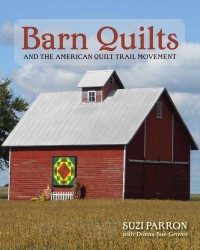
Parron book coverThe Larson corncrib was selected for the cover of “Barn Quilts and the American Quilt Trail Movement.”  The book traces the trail to its beginnings in Ohio and takes readers to 29 states from New York to Colorado with over 80 photographs taken along quilt trails across the country. It also includes dozens of interviews with barn owners, who relate the significance of their chosen quilt patterns along with stories about the barns on which they are mounted.

Each of the 150 known barn quilt trails celebrates a community’s farming heritage.  Although quilt squares are the main attraction,barn enthusiasts may find quilt trail maps to be invaluable guides in their travels through America’s countryside. Information about Parron’s book, The Posy Collection, and the nation’s quilt trails can be found at www.barnquiltinfo.com.