How Unique is the Squire-Hennes Barn?

Long-time NBA member, Mona Hennes has put extraordinary energy and effort into researching this beautiful and unique barn that holds a special place in her family history. And the publication she has put together is testament to her diligence!  Mona was kind enough to share her masterpiece with us and allow the NBA to reprint a portion of it here.  A larger and more detailed article will be featured in the upcoming issue of our printed newsletter, The Barn Door.

Mona is very interested in this barn type and its construction methods, and is eager to identify others like it.  If you know of a similar barn elsewhere in the country, please post a comment below to help her learn more!  

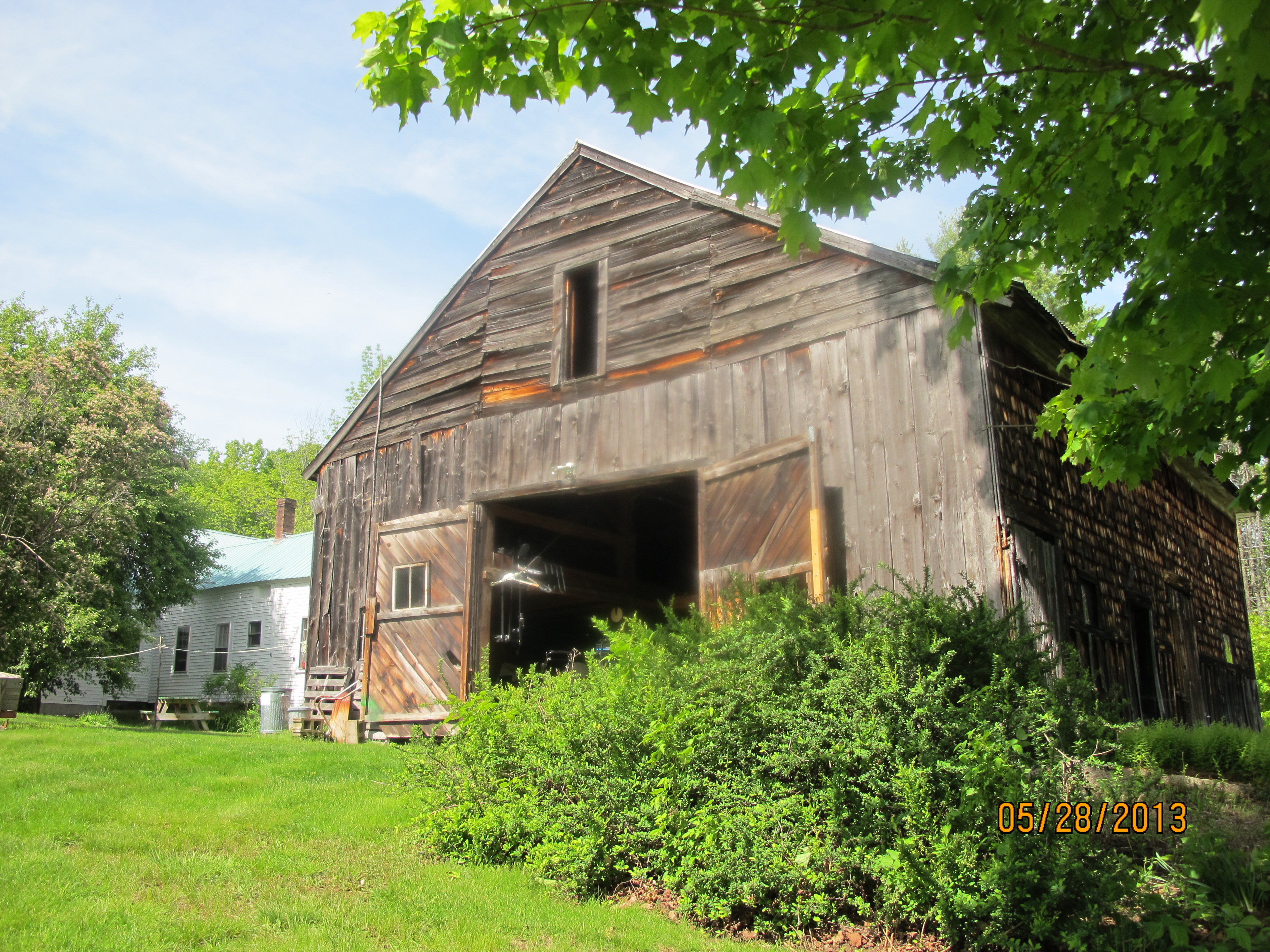
In 1850, the seven member John Squire Family were among thousands of immigrants who came to the United States in search of a better life. The ship manifest lists Frederick Squire at age 3 when he traveled to America. Frederick grew up in Iowa and Indiana and married Frances E. Dean in 1866. Like hundreds of others, the young couple bravely carved out land as homesteaders in Lulu Township, Mitchell County, Kansas in 1870. Frederick and Frances Squire fulfilled their homestead requirements including building a house, digging a well, plowing, planting crops and living off the land. In the end, they raised a family and became respected Mitchell County land owners who were responsible for the construction of a most remarkable barn in the fall of 1888.
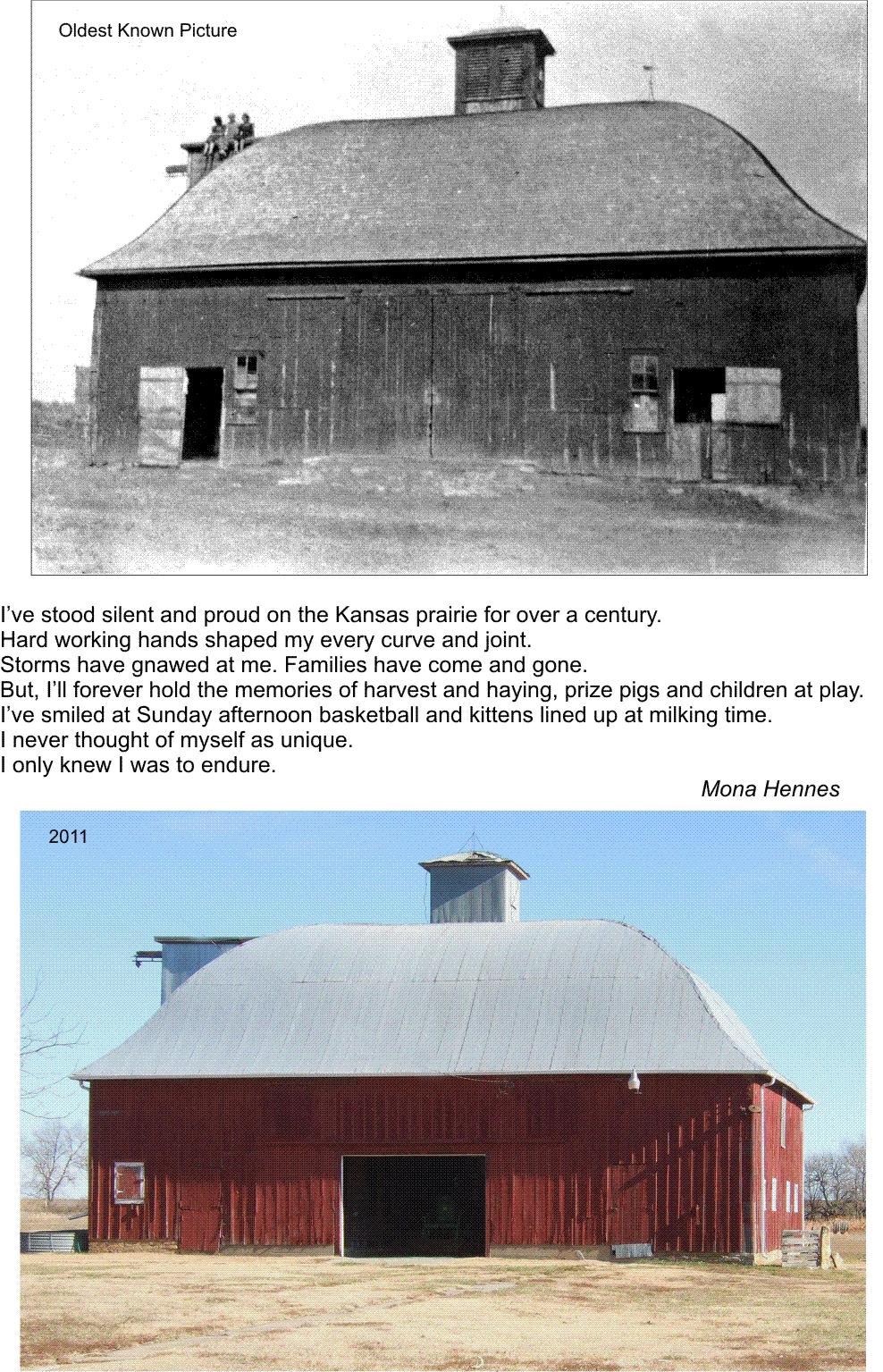
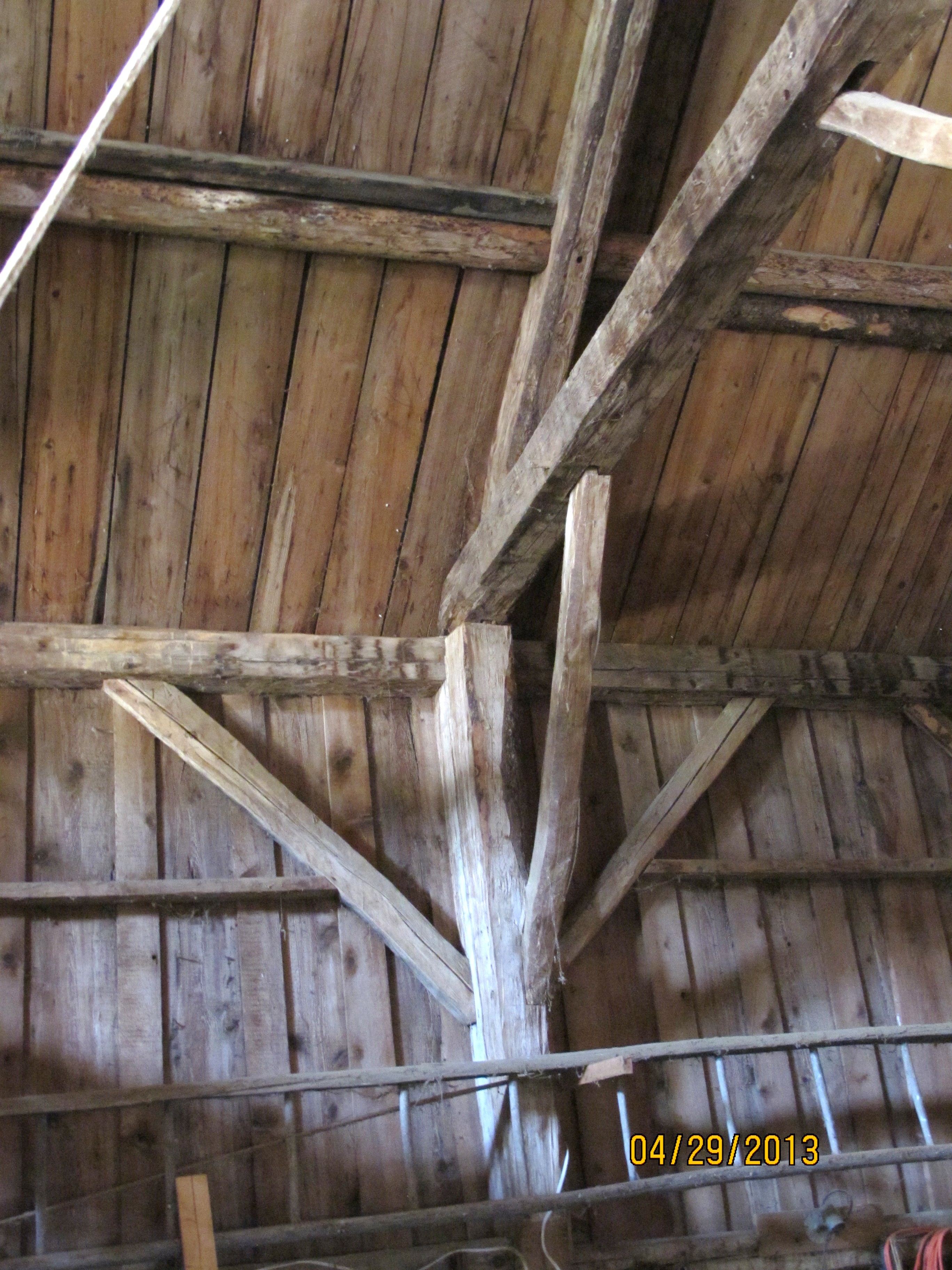
Images of the Squire-Hennes Barn, Courtesy of Mona Hennes.  Author's Permission Required for Reprinting.

Images of the Squire-Hennes Barn, Courtesy of Mona Hennes. Author’s permission required for reprinting or re-use of this material.

Mr. Squire’s barn was 40′ by 58′ by 32′ high and built by Hamilton Lee Wiley, a contractor from Beloit, who partnered briefly with a carpenter named Eli Pfrimmer Newbanks.  A second generation American of French descent, Newbanks grew up in Corydon, Indiana, and came to Mitchell County, Kansas, with his wife’s family as a homesteader around 1871.  He was well educated in carpentry and architecture.

During his career, Newbanks worked on large construction projects including The Alpine Tunnel built for the D&RG Narrow Gauge railroad in Gunnison, Colorado.  He also worked on projects in Louisiana, Texas and Missouri.  For a short time (~1882 to 1886), after the untimely death of his wife Delilah, Eli Newbanks partnered with Hamilton Wiley in his Beloit Contracting Business. Their advertisement appeared weekly in the Beloit Gazette.

In 1884, Eli became the lead carpenter for an octagon barn, built in Scottsville KS, just nine miles north and east of the Squire-Hennes barn. This barn, built for C. W. Culp, owner of Eureka Stock Farm, was the pinnacle of local construction jobs. While the barn no longer exists, it had the same ogee roof design as the Squire-Hennes barn. Winning this contract was a huge plus for Hamilton Wiley’s business reputation. One year later, 1888, Hamilton Lee Wiley built the Squire-Hennes barn for Frederick F. Squire.

In 1893, twenty three years after he homesteaded his farm in Lulu Township, Frederick Squire moved to Beloit and left his 600+ acres of property to be farmed by others. He died suddenly of appendicitis in January of 1899 and was buried in Elmwood Cemetery in Beloit. His properties were divided among his children, with the home farm passing to his son, John.  When John Squire left Kansas around 1915, he rented the Squire farm to Caspar Hennes, my grandfather, who was living just one mile west.  Caspar Hennes (Grandfather), Fred Hennes (Dad,) and John Hennes (Uncle) farmed the property for the Squire family until ~1928, when Fred and John Hennes purchased some of the land, the farm house and buildings.

My Dad bought out the interest of his brother, John Hennes, around 1943.  My brother Jim Hennes farmed the land and cared for the barn until the mid-1970s. He tinned the barn’s roof which probably preserved the structure. My nephew, Mark Hennes, still farms land for the Records family. Howard Records, who lives in Arizona, is the great grandson of Dr. Thomas E. Records, husband of eldest daughter Lora E. Squire.
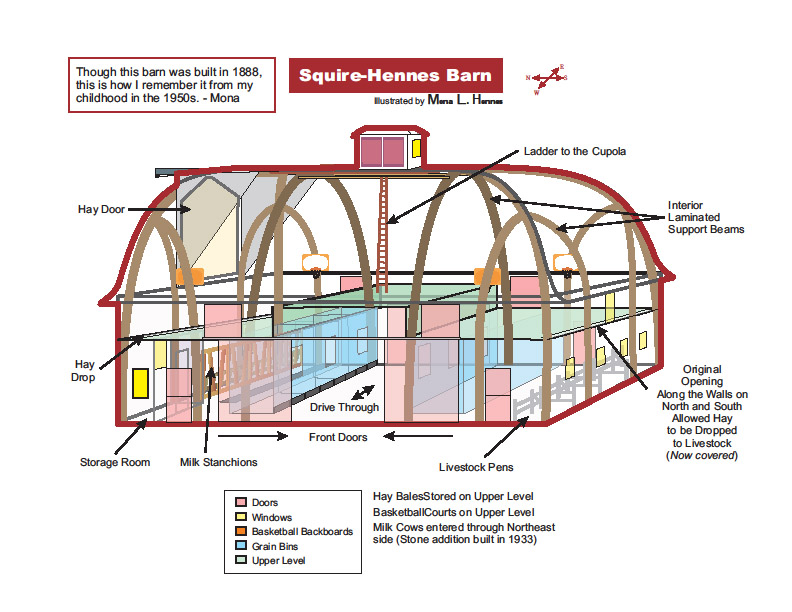
Mona Hennes' Plan and Depiction of the Barn's Interior.

Mona Hennes’ Plan and Depiction of the Barn’s Interior. Author’s permission required for any re-printing or re-use of this image.
Barn Again! in Indiana – September 19, 2014

This guest post by Raina Regan, a preservationist working hard to bring attention to barn preservation at Indiana Landmarks, the statewide “nonprofit organization, fighting to defend architecturally unique, historically significant, and communally cherished properties…” in Indiana.  NBA is thrilled to see the dedication of those barn-loving Hoosiers!  This Barn Again! workshop is not a new thing for Indiana Landmarks and they sure know how to do it right – don’t miss out on this great event.

Although located directly east of metropolitan Indianapolis, Hancock County, Indiana is rich in agricultural heritage. Driving county roads, you’ll find timber frame barns and steel silos dotting the slightly rolling landscape.  This fall, don’t miss Indiana Landmarks’ BARN AGAIN! workshop in Hancock County to explore this historic community while learning about barn preservation.

HABS_LittletonRoundBarnThis day long workshop on September 19 will provide practical solutions from experts on how to maintain, rehabilitate, and adapt old barns for today’s needs. Participants will learn about the history and technology of barns as well as barn maintenance, adaptive reuse, and preservation. Rick Collins of Trillium Dell Timberworks will headline our workshop speakers. The workshop will also highlight a new Indiana law which offers a 100 percent property tax deduction for heritage barns not used for farming or business purposes.
The afternoon will include a tour of four barns in northern Hancock County, providing an opportunity to learn about the design, history, and rehabilitation of historic barns. The tour includes a stop at the award-winning, National Register-listed Frank Littleton Round Barn. The Littleton Round Barn dates from 1903 and is an impressive true circular barn with a 102’ diameter. The barn was commissioned by Indianapolis attorney Frank Littleton, who called upon Benton Steele for the design. Steele had recently built the largest round barn in the state, a 100’ diameter round barn for Littleton’s rival, Congressman Wymond L. Beckett. As the story is told, Littleton had Steele build his barn just a little bit larger, for a total of 102 feet in diameter, so that he could beat out his rival.  Constructed by Issac McNamee and Horace Duncan, the Littleton Round Barn still holds the title for largest round barn in the state of Indiana.  We’re excited to include the property on our barn tour to highlight this impressive structure which continues to function in an agricultural use.

Phares Dairy Barn

Phares Dairy Barn

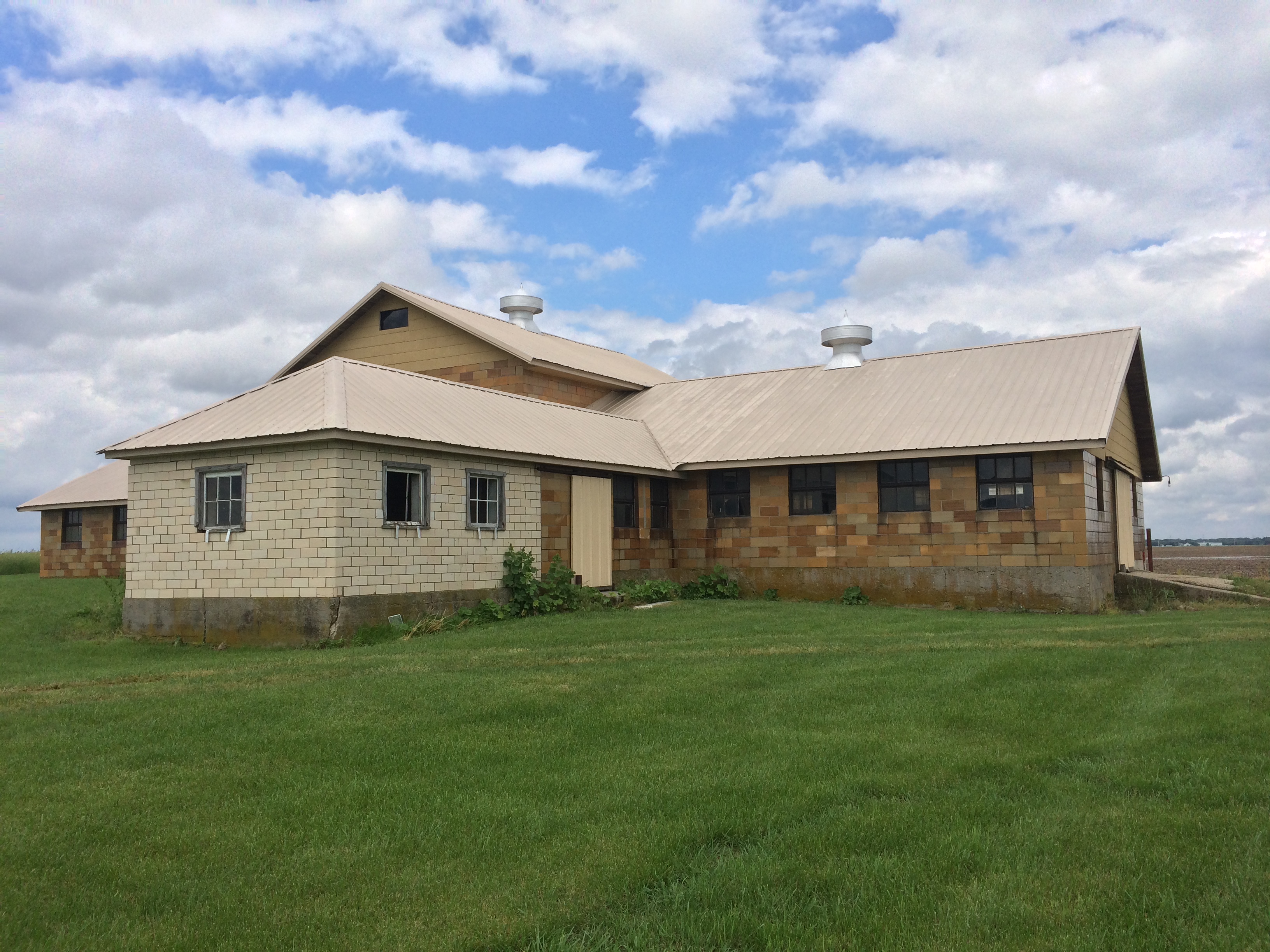
Other barns on the tour include a depression-era Dairy Barn and an unusual transverse frame basement barn – featuring rusticated concrete blocks cast on site. Our fourth barn is a 19th century timber frame barn, which sits on an early Hancock County farm dating from the 1830s. The tour promises to highlight a wide variety of historic barn types, perfect for anyone passionate about agricultural heritage.

The BARN AGAIN! workshop will be held at NineStar Connect Conference Center, 2243 East Main Street, Greenfield, IN 46140. Cost for the day-long workshop is $45 and includes lectures, lunch, an informational packet, and the barn tour. There is a discounted price for members of Indiana Landmarks. The reservation deadline for the BARN AGAIN! workshop is September 15. Register online at barnagain2014.eventbrite.com or contact Indiana Landmarks at 800-450-4534. Questions? Contact Raina Regan, Community Preservation Specialist, 317-639-4534, rregan@indianalandmarks.org.

New Indiana Barn Foundation Hard at Work!

Indiana Barn FoundationA passionate and motivated group of Hooisers have been working hard to establish a barn organization for the state of Indiana in recent months – and what great success they have had in such a short period of time.  The first annual meeting of the Indiana Barn Foundation is coming up on July 12th and the group can already boast of supporting barn preservation legislation!  Last month, members of the organization were in Indianapolis to witness Governor Pence sign Bill 1046–a law that allows for a property tax deduction on historic barns in Indiana.  Way to go Hoosiers and congratulations to Indiana’s historic barns!
We know great things are in store for this wonderful new barn preservation organization, and hope you will lend them your support in the effort.  Below is a description of the group’s purpose and goals taken from their website.  Please share this information with anyone you think would be interested and encourage them to attend the meeting on July 12th at the Indiana state fairgrounds! 


“Indiana Barn Foundation is being established to unite those of us who value the legacy of Hoosier farmers who have worked against the odds, often singlehandedly and with no financial incentive, to maintain and preserve these landmarks. We see Indiana’s historic barns as being an asset to Indiana’s larger cultural heritage; an asset worth preserving by assisting our farmers who struggle to maintain them. 

Our Proposal:  We are establishing, in conjunction with several other organizations, a private, nonprofit 501c3 mechanism to  provide grants to rehab historic Indiana barns. We expect to operate efficiently under the umbrella of the Indiana Barn Foundation, while enlisting the expertise and resources of the Indiana Farm Bureau, Indiana Landmarks, the National Barn Alliance and many other groups who will join us in this work.

To keep this work alive for future generations, we also foresee the Indiana Barn Foundation some day financing educational programs, producing workshops and educational materials, and surveying and documenting existing barns.

The effort to save Indiana barns will need the support and dedication of many people, and we invite you get involved in this exciting undertaking! We have the opportunity today to do more than despair at the disappearance of another Hoosier landmark.  Indiana barns have stood as a silent testament to the hard work and resourcefulness of those who settled this grand land of ours. We have a responsibility to care for and preserve our heritage now, and for future generations.”

 It couldn’t be said any better; kudos from the NBA to the Indiana Barn Foundation!

In Madison, New Hampshire – A Tour of 100 Year Old Barns

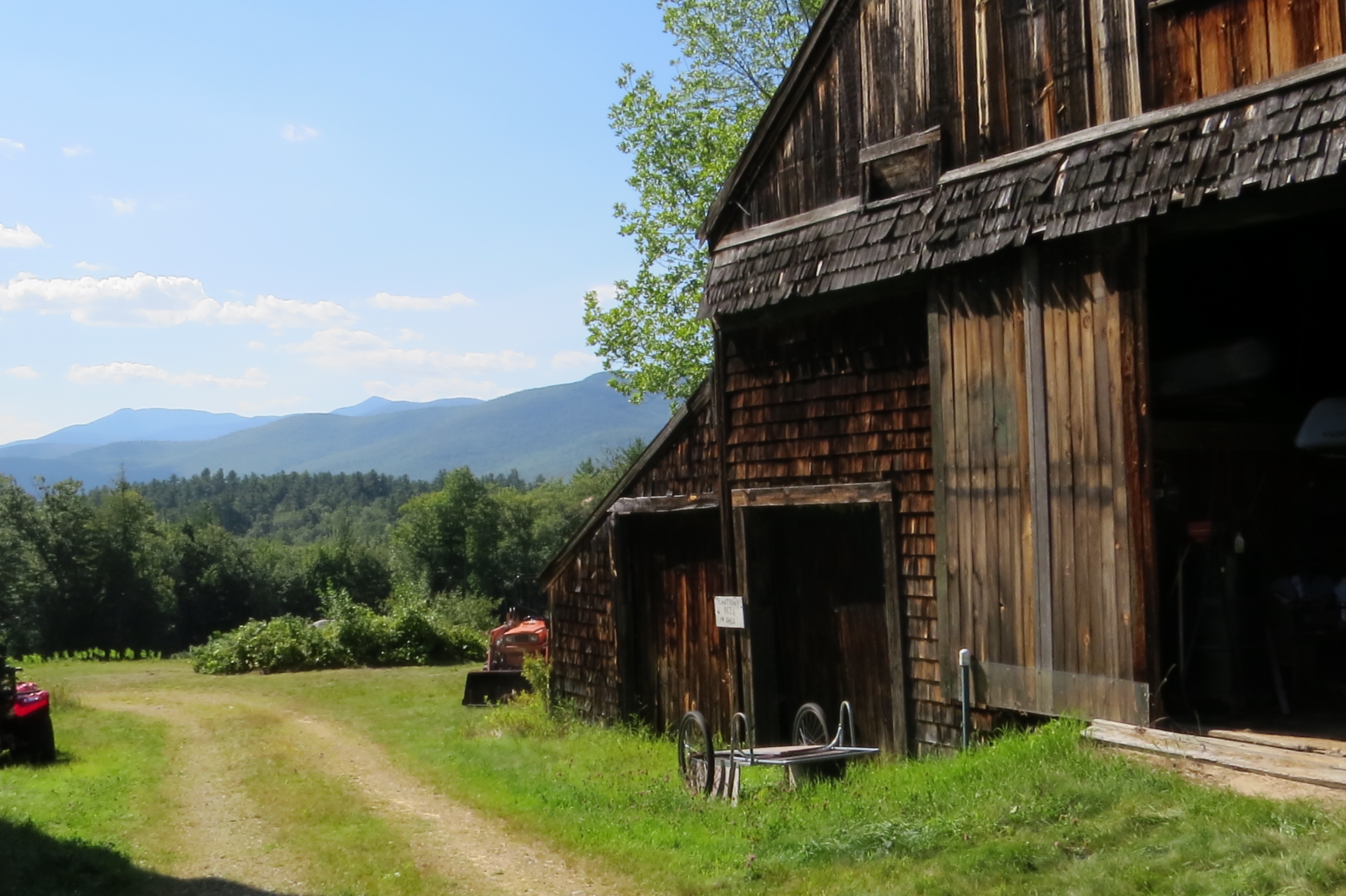
view from Joy Farm

View of Joy Farm

This post comes from our barn-loving friends in Madison, NH.  This is the first year of their barn tour, but it will certainly not be their last!  What a great event!

The Madison Historic Barn Tour weekend, July 11 & 12, 2014 is fast approaching. With seven wonderful old 18th and 19th century barns on the tour, including E.E. Cummings’ Joy Farm, interest is growing rapidly.  The small Town of Madison is located in the beautiful Mount Washington Valley of New Hampshire. Incorporated in 1852, Madison has a long and interesting history as a farming and tourist community.

Town tax records reveal that there are approximately 50 barns in Madison which are over 100 years old.  The Friends of Madison Library (FOML), a 501(c)(3) non-profit supporting the local public library, has organized this weekend fundraiser (be sure to visit their website).

Barns on the tour, in addition to Joy Farm, include the Ambrose Barn built in the mid-1870s by then owner Henry Harriman with timbers from his neighbor’s barn. Nearby is the Old Public Burying Ground where several of Madison’s Revolutionary War soldiers are buried.

Ambrose Barn

Ambrose Barn

The Gilman Barn built circa 1795 as a working farm has been in the Gilman family since then. Built with wooden pegs and resting on a loose field stone foundation, Alan Gilman’s barn is as “square” today as the day it was built. The large “Gilman Cemetery” across the street is the final resting place of generations of Madison residents, including the original owners of several of the Tour Barns.

The Henry Harmon place c 1850 may have been built earlier at Madison Corner, then moved by oxen to the open meadows of Goe Hill. A painting of this barn by Andrew Haines was recently on display at the Boston Museum of Fine Arts.

Come to Madison to see all seven tour barns. A list of the other forty plus Madison barns over 100 years old will be available for those who want to do more independent exploring. Directions to the numerous fascinating local cemeteries may lead you to find the resting places of former barn owners, or ancestors of your own. Pick up a copy of Mary Lucy’s book Cemeteries and Graveyards of Madison, NH from the Madison Historical Society. Browse the Barn themed Art Show, purchase barn note cards and photo sketches, or place a bid on a photo or professional work of art in oil or watercolor at our Silent Auction.

Gilman Barn

Gilman Barn

Don’t miss barn historian Bob Cottrell’s talk and discussion of 18th and 19th century New England Barns on Friday night at the Madison Library. Bob has a Master’s Degree from the Winterthur Program in Early American Culture. He has worked in the history/museum field since 1980. Previously, Bob worked at the Smithsonian’s National Museum of American Art in Washington, D.C., the Crowley Museum and Nature Center in Sarasota, Florida, the St. Petersburg Historical Museum also in Florida, the Conner Prairie Museum in Indiana and at Bilkent University in Ankara, Turkey. In 1996 he became the founding Director of the Remick Country Doctor Museum and Farm in Tamworth, New Hampshire, another great place to visit while you are here. Bob’s talk is included in the price of the Barn Tour.

At the southern end of the Mount Washington Valley, the village of Madison is just minutes away from numerous hotels, picturesque B&Bs, wonderful restaurants and the tranquility of our natural setting around Silver Lake. Make plans now to spend a day or two before or after the Barn Tour.  Bring a blanket and buy a Barn Tour Bag Lunch to enjoy at one of our Town Beaches or in the garden at the Library.

Tickets on the weekend of the Tour will be $20 per person. Advanced tickets may be purchased before July 1, 2014 for $15 per person, payable by check to Friends of Madison Library at PO Box 240, Madison, NH 03849.

All proceeds of Barn Tour events benefit the non-profit Friends of Madison Library. For more information send an email to FOMLibrary.NH@gmail.com

Bucks County Community College Sets Rural Stage for NBA’s 2014 Winter Meeting!

**Our 2014 Winter Meeting was canceled due to inclement weather, but the NBA is trying to partner with BCCC once again in 2015!  This time around, the meeting will take place on February 21-22, 2015.

This guest post comes from Patricia Fisher-Olsen, Coordinator of the Historic Preservation Program  and lecturer at Bucks County Community College (BCCC) in eastern Pennsylvania.  This year BCCC has agreed to host the NBA’s Winter Meeting at their 200-acre Newtown campus where several of the school’s NRHP-listed buildings have been re-adapted to serve as classrooms – enhancing the learning environment for all its visitors!  From 11:30 am to 1:30 pm, Saturday, February 15th, the NBA’s Winter Meeting is open to the public.  We encourage any barn enthusiasts in the vicinity to join us as we learn more about barns in the region and what all the students at BCCC are doing to save them!  The lecturers are free though small donations to help cover the cost of lunch are welcome.

In 1991, BCCC became the first school in the country to offer a 24-credit Certificate Program in Historic Preservation and since then the campus program has grown and expanded online, offering students the unique opportunity to complete their Historic Preservation Certificate entirely over the Internet. Students opting to take courses on our Newtown campus will find them immersed in a working preservation laboratory. Classes and lectures are taught in buildings listed on the National Register of Historic Places, surrounded by historic landscapes and formal gardens. Students opting to take courses through our online campus will find themselves immersed in the preservation laboratory of their own communities.  The online courses are designed to leverage the historic resources in all areas of the country.

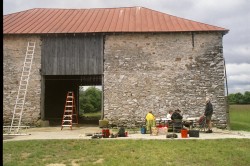
BCCC Students at Work Documenting Best Barn.

BCCC Students at Work Documenting Best Barn.

In 2008, Bucks students won the coveted National Parks Service/American Institute of Architects’ Charles E. Peterson Prize, which annually recognizes the best set of measured drawings prepared to Historic American Building Survey (HABS) standards by college or university students.  At BCCC, the HABS program operates as part of the institution’s Historic Preservation Department.  The program offers students the opportunity to measure and record the architectural details of historic structures as they exist today, before they are further altered by time, nature and people.  By studying clues, such as the changes in mortar and other materials applied to a structure, HABS students document both a building’s history and the history of the people who made the changes.

Since 1991, Bucks County Community College faculty member, Kathryn Auerbach, has led several teams of HABS students as they measured and documented historic structures here in Bucks County and across the country.  The recorded findings of the students, many of whom have no previous architectural or building experience, have become part of the collection at the Library of Congress to be used for future research.  The college competes for the best architectural measured drawings of a historic American structure in the Charles E. Peterson HABS Prize Competition sponsored by the National Park Service, the American Institute of Architects and the Library of Congress.

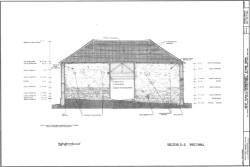
Measured Drawing of Best Barn, Frederick, MD.

Measured Drawing of Best Farm Stone Barn, Frederick, MD (BCCC 2008).

The yearly contest is highly competitive, with entries from architecture and design programs at nationally recognized universities. Several of BCCC subsequent HABS classes have gone on to secure a Honorable Mention,  4th place, 3rd place and even 1st place in the competition. In 2008, BCCC – the only community college entrant – won a highly coveted 1st place award for their work with the National Park Service on the Best Farm Stone Barn, located on the Monocacy Battlefield in Frederick, Maryland.

In Bucks County during the 1930’s, many of the HABS projects involved old stone barns that were very prevalent in this part of the country.   Today, thirty percent of the barns that were documented no longer exist.  Without the HABS sets of measured drawings and photographs, no evidence would exist of some of Bucks County’s beautiful stone barns, nor of the people who built and used them.

Students who participate in the HABS class at BCCC not only learn about historic architecture but also develop important problem-solving skills.  Many of our HABS drawings will be on display during the National Barn Alliance Winter Meeting.